Language-service savings should begin with a simple constraint: reduce avoidable cost, not the controls that let people understand information and participate. For UK procurement teams, the working scope can include translation, interpretation, transcription and British Sign Language (BSL). These services support communication and access, so a lower quoted rate is only one part of a sound purchasing decision.
This guide sets out a practical way to establish demand, specify the controls that matter, test savings opportunities, and review outcomes. It is designed to help teams make changes that are evidence-led and reversible where necessary.
Set the cost-control baseline
Start by defining what the organisation is trying to control. The objective is not simply to buy the cheapest unit of translation or interpreting; it is to reduce unnecessary demand and inefficient purchasing while retaining the quality, accessibility and accountability requirements of the service.
For schools, official buying guidance describes language services as including translation, interpretation and transcription, with BSL included within interpretation to support SEND inclusion. That is a useful reminder to agree the scope before comparing costs: written documents, websites, meetings, phone or video interpretation, and accessible communication may have different requirements and risks.
Create a short baseline statement for each service area. It should identify the intended audience, the communication outcome required, the accessibility requirement, the acceptable turnaround time and the evidence needed to confirm satisfactory delivery. Use this statement as the decision rule for every proposed saving.
For broader buying-route guidance, see the related language-services procurement guide.
Map demand and current spend
 Map current activity before changing suppliers, service levels or routing. A complete picture should distinguish four sources of cost:
- Demand: who requests work, what languages or formats are needed, how often work is urgent, and whether requests are avoidable or repetitive.
- Purchasing process: how requests are approved, how quotations are obtained, whether work is bought ad hoc, and how invoices are checked.
- Supplier management: the number of suppliers, agreed service expectations, escalation arrangements, and the information available to compare performance.
- Delivery workflow: preparation of source material, briefing, reuse of approved content, hand-offs, amendments and rework.
Record spend and volume together. Useful fields include service type, language pair or communication format, requester, supplier, request date, delivery date, unit basis, total cost, urgency, amendments, complaints, accessibility requirements and outcome. Without these fields, a team may mistake a mix change—for example, more urgent or complex work—for supplier price inflation.
Also mark work that cannot be treated as interchangeable. BSL, face-to-face or video interpretation, translated safeguarding material, and material for people who need accessible information may require specific service controls. The purpose is not to create unnecessary administration; it is to prevent a cost comparison from omitting the requirement that made the service necessary.
Asset: School language-services purchasing range
Place a real, licensed official-service visual here showing translation, interpretation, transcription and British Sign Language. It should support the demand-and-spend baseline; do not use AI imagery.
A procurement spend-analysis template can help turn this baseline into a consistent review.
Protect quality with clear service controls
AI-generated generic editorial illustration — not a retailer product photo and does not depict the reviewed product or service. Help readers weigh savings proposals against quality assurance, accessibility, and accountability controls.
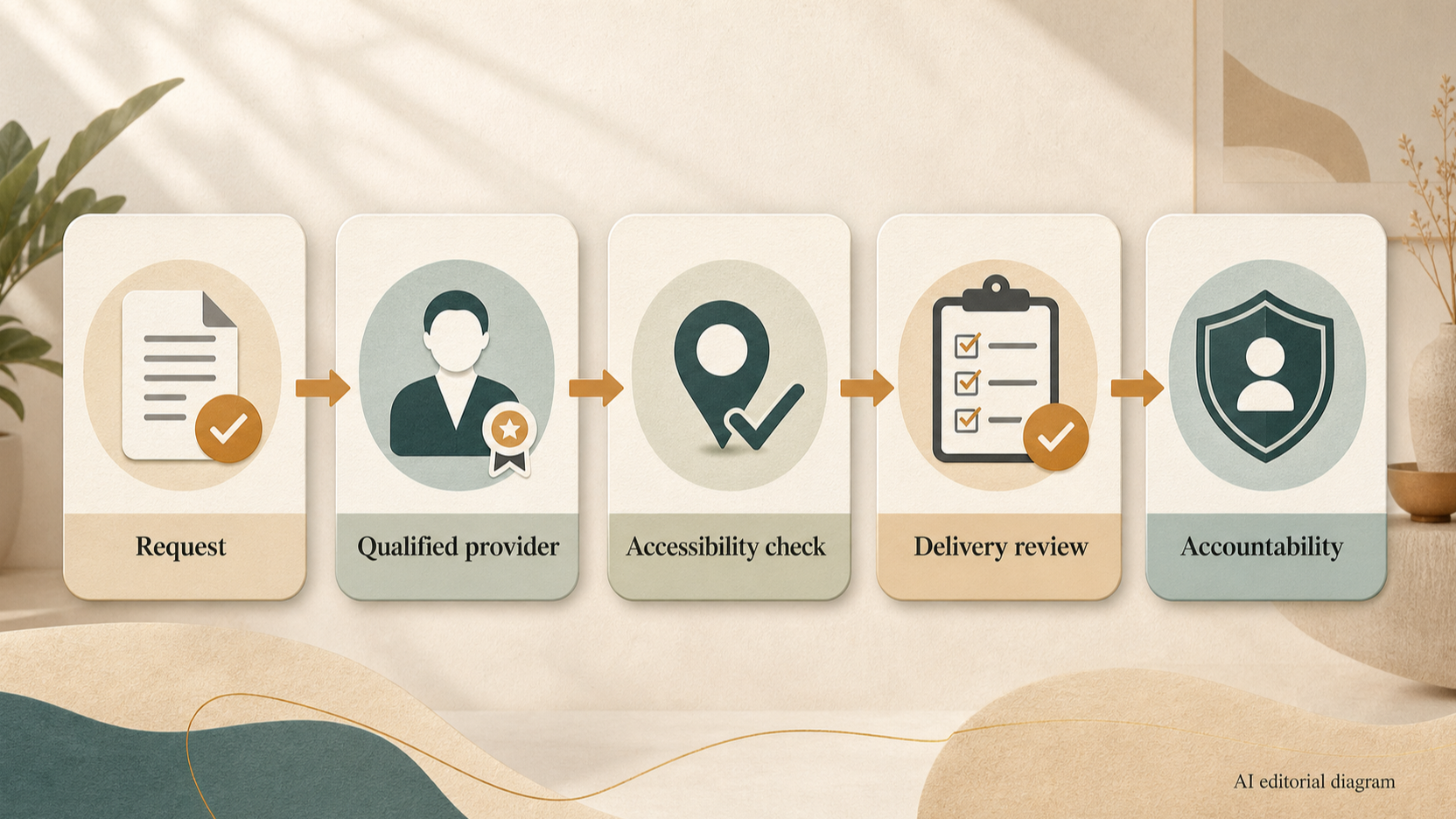 Set the non-negotiable controls before asking suppliers to improve pricing. A specification should state the required service outcome, relevant qualifications or capability expectations, briefing and confidentiality requirements, accessibility needs, response times, delivery format, review process and escalation route.
This makes suppliers more comparable. It also prevents an apparent saving from being created by silently removing a necessary control, such as an accessibility check or a documented delivery review. The Association of Translation Companies notes that language-service standards set basic requirements and quality expectations, and can provide criteria for objectively assuring provider professionalism. Teams do not need to claim that a particular standard guarantees an outcome; they can use documented requirements to make expectations visible and assessable.
For each service category, decide which measures will be reviewed after delivery. Examples include turnaround against the agreed requirement, completeness of the delivered format, accessibility issues raised, correction or rework requests, incidents, and the time taken to resolve them. Keep a clear owner for accepting work and escalating issues. This establishes accountability even when the purchasing route or supplier changes.
Asset: Language-service quality-control decision flow
Show: request → qualified provider → accessibility check → delivery review → accountability. Prefer a real, licensed source visual. If none is suitable, use a clearly disclosed AI editorial diagram only.
Use a translation quality-assurance checklist to convert these controls into a repeatable acceptance process.
Apply savings levers across the service lifecycle
Once demand and controls are visible, test savings levers across the full lifecycle rather than relying on rate negotiation alone.
Consolidate predictable demand. Bring recurring requests into a shared view so teams can plan volume, avoid duplicate orders and give suppliers clearer briefs. Consolidation should not force unlike services into one route; retain separate controls where the communication need or accessibility requirement differs.
Plan earlier. Record whether requests are genuinely urgent or arrived late in the internal process. Earlier notice can reduce avoidable rush activity and make it easier to match the right service to the requirement. Measure the effect rather than assuming all urgent work is avoidable.
Improve source material and reuse approved content. Maintain an owner for approved source content, terminology and recurring documents. Reuse should be controlled: material must remain current, appropriate for the audience and checked against the new context. Reusing outdated content simply moves cost into correction, complaint handling or inaccessible communication.
Use fit-for-purpose service tiers. Define what each request needs before it is routed. A simple internal translation, a public-facing document, a live meeting and a BSL-supported interaction may require different qualifications, formats, review steps and turnaround expectations. The tier should follow the documented requirement, not be selected solely because it has a lower price.
Structure buying routes and supplier management. Reduce unplanned purchasing by using an approved request, quotation and acceptance process. Agree what suppliers must report, how exceptions are handled and when performance is reviewed. This gives procurement teams a factual basis for comparing total delivery performance, not just unit pricing.
Pilot one or two levers first. For example, a team could introduce an earlier-intake step for a defined group of recurring documents while retaining the existing quality controls. Compare the pilot with the baseline on cost, turnaround, acceptance, accessibility issues and rework. If a saving only appears after excluding correction work or delayed delivery, it is not yet a reliable saving.
Related tools include a supplier-management playbook and a translation-memory governance guide.
Avoid false economies and procurement pitfalls
Treat price as a component of total cost and risk. A proposal can look cheaper while increasing rework, delivery delays, accessibility issues, complaint handling or the burden on internal staff. It may also be unsuitable if it does not meet the documented capability, quality-assurance, capacity or contractual requirements.
Check the status of any agreement before presenting it as a current buying route. The Government Commercial Agreement listing for RM6141 Language Services identifies it as expired, with an end date of 9 May 2025, and says the information is for reference only. Its historical scope included translation, transcription, interpreting and a quality-assurance service. An expired agreement may help a team understand previous arrangements, but it should not be assumed to be an available route for a new purchase.
Avoid these common errors:
- Comparing rates without comparing service specification, accessibility requirements and acceptance evidence.
- Moving work to a lower-cost route before confirming supplier capacity and escalation arrangements.
- Treating reduced supplier invoices as a saving when internal rework has increased.
- Removing delivery review or accountability because the service is labelled routine.
- Applying the same service tier to requests with materially different communication or inclusion needs.
Where a proposal changes controls, write down what has changed, who accepted the risk and what review signal would trigger corrective action. This preserves a defensible decision trail.
For route-selection context, consult the UK public-procurement frameworks guide.
Implement and review the savings plan
Use a staged implementation so that savings measures can be tested without normalising a poor outcome.
- Baseline. Capture current volume, spend, turnaround, accessibility needs, rework and supplier-performance information for the defined service group.
- Specify. Confirm the required service outcome and non-negotiable controls. Assign an accountable owner for acceptance and escalation.
- Pilot. Apply one clearly defined change to a limited request type, supplier group or period. Keep the baseline controls in place unless the approved pilot explicitly changes one.
- Measure. Review cost alongside quality, turnaround, accessibility signals, amendments, complaints and supplier responsiveness.
- Decide and govern. Continue, adjust or stop the change using documented evidence. Record the rationale, actions for suppliers and the date for the next review.
A useful scorecard should show both leading and lagging signals. Leading signals can include incomplete briefs, late requests or missed response times. Lagging signals can include invoice cost, rework, delivery failures, accessibility concerns and resolved escalations. No single metric should decide the outcome: a reduction in average unit price does not establish success if the service no longer achieves the required communication or access outcome.
Use a supplier-performance scorecard and procurement-pilot framework to keep reviews consistent across teams.
Frequently Asked Questions
How can we reduce translation spend without removing quality assurance?
First identify repeatable demand, avoidable urgency, duplicated requests and weak source-material preparation. Then retain a documented specification, acceptance process and post-delivery measures while testing a limited savings change. Quality assurance should remain a visible control, not an assumed supplier attribute; language-service standards are intended to set basic requirements and quality expectations that support objective assurance of provider professionalism.
Should we use an expired language-services agreement as a current buying route?
No. RM6141 is marked as an expired agreement, ending on 9 May 2025, and its listing says the information is for reference only. Use it only as historical context, then confirm an appropriate current route and whether it meets the organisation’s requirements.
Which language services need explicit accessibility and service-level controls?
Apply explicit controls whenever the required outcome depends on accessible communication, timing, delivery format or provider capability. Official school-buying guidance identifies translation, interpretation, transcription and BSL-supported interpretation within language services, including support for SEND inclusion. The exact controls should reflect the specific request and audience.
What should be measured after changing a language-services supplier or workflow?
Measure total cost with delivery performance: turnaround against the agreed requirement, acceptance, amendments or rework, accessibility issues, complaints or incidents, and the supplier’s response to escalation. Review those signals against the pre-change baseline before expanding the change.
For additional context, see the language-services procurement guide and translation quality-assurance checklist.
Sources
- Get Help Buying for Schools: Language services
- Government Commercial Agreement: RM6141 Language Services
- Association of Translation Companies: ISO standards
Related reading
- Business Services Provider Evaluation
- How to procure interpreting services for hybrid meetings and regulated conversations
- Remote interpreting vs on-site interpreting: which service model fits your organisation?
- Best corporate language training provider models for UK employers
Editorial information: About our editorial team · Read our editorial policy · Read our affiliate disclosure.