Interpreting procurement is a service-design decision, not simply a comparison of hourly rates. The team needs to match the meeting format, language needs, participation channels, confidentiality expectations and escalation route to the risks of the particular conversation. That is especially important where some participants are remote, others are in the room, or the subject matter is legal or otherwise tightly governed.
The sources used here provide a practical boundary for that work. NHS England’s 2025 improvement framework is intended to support consistent, high-quality community-language translation and interpreting services for people with limited English proficiency. ISO 20228:2019 sets out principles, practices, interpreter competences and mode recommendations for legal interpreting. The UK Visas and Immigration interpreter code describes the role, responsibilities and professional standards expected for its assignments. NHS England ISO GOV.UK
Procurement Scope for Hybrid and Regulated Conversations
Start by defining the communication problem before inviting suppliers to respond. Record who needs to take part, the languages and communication modes involved, whether people will join remotely or in person, and what decisions or actions the conversation could affect. A hybrid meeting can fail even where an interpreter is present if remote participants cannot hear the relevant speaker, cannot enter the correct channel, or are not included in turn-taking.
The scope should distinguish ordinary operational meetings from conversations with a higher consequence for error, fairness or confidentiality. Legal interpreting is a defined field in ISO 20228:2019: the standard applies to parties facilitating communication between users of legal services through spoken or signed language, and addresses legal settings, interpreter competence and corresponding interpreting modes. A general language-service specification should therefore not be assumed to cover every legal assignment. ISO
For public-service settings, write the intended access outcome in the procurement record. NHS England’s framework is specifically directed at consistent, high-quality community-language translation and interpreting services for people with limited English proficiency. This gives a buyer a grounded reason to ask how the proposed service supports access, rather than treating language need as an optional meeting add-on. NHS England
A useful first output is a short assignment profile: meeting purpose; participants and locations; languages; spoken or signed communication needs; platform and room arrangements; sensitivity; preparation material; decision owner; and contingency route. Use that profile consistently when comparing suppliers and when booking individual assignments.
Capabilities That Support Hybrid Meeting Delivery
AI-generated generic editorial illustration — not a retailer product photo and does not depict the reviewed product or service. Help procurement teams turn mixed-participant meeting needs into a practical delivery specification.
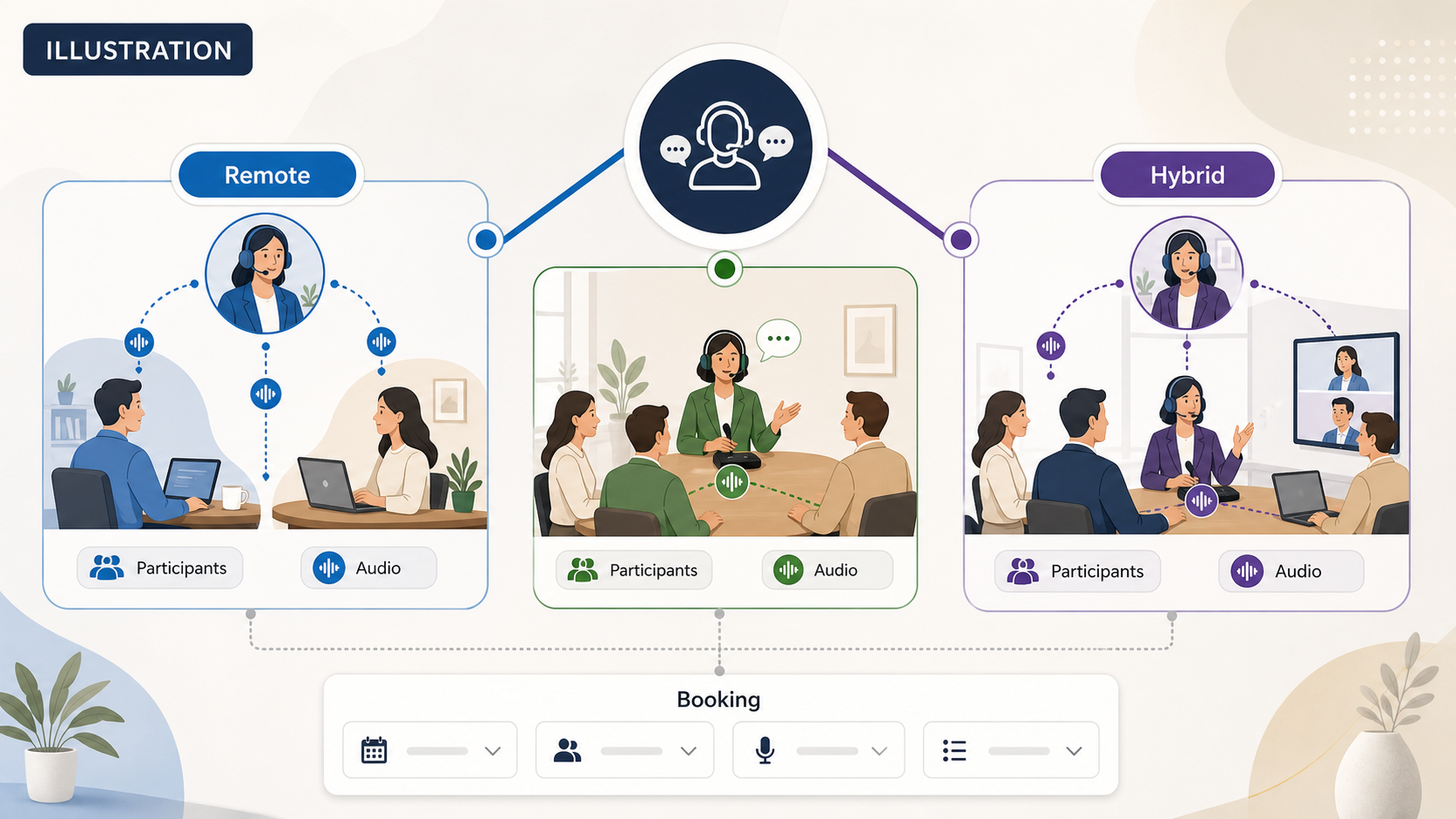 A hybrid specification should describe the delivery environment, not merely label an assignment “remote” or “face-to-face”. Ask the service provider to explain how the interpreter receives the meeting invitation, joins the appropriate virtual or physical space, hears every participant, and is introduced to the people relying on interpretation. The buyer should also establish who controls the platform, how access details are issued and how last-minute changes are communicated.
The required capability will vary with the meeting pattern. For an entirely virtual meeting, the key question is whether participants and interpreter can use the agreed platform and audio arrangement reliably. For an in-room meeting with a remote participant, the specification should make clear how speech from the room reaches that participant and how the participant’s contribution reaches the interpreter and room. For a mixed meeting with multiple sites, name the host, booking contact and escalation contact for each location.
NHS England frames its guidance around consistent, high-quality community-language translation and interpreting provision for people with limited English proficiency. Procurement teams can translate that aim into testable operational questions: how will the booking capture language need; how will the service confirm the delivery mode; who will check that the participant can access the meeting; and what happens if the planned channel is unavailable? NHS England
Continuity matters where a conversation spans several sessions or depends on prior context. Rather than assuming continuity will be available, state whether it is required, how changes of interpreter will be communicated, and what preparatory information may be shared. Define a fall-back arrangement as well: for example, a named operational contact, a decision point for postponement, and an agreed method for documenting a delivery incident.
The deliverable should be a service schedule that records the approved meeting modes and the controls for each. It gives the provider an unambiguous basis for staffing and gives internal meeting owners a checklist for making the arrangement usable in practice.
Limits and Risks in Regulated Conversations
AI-generated generic editorial illustration — not a retailer product photo and does not depict the reviewed product or service. Make regulated-conversation risks concrete so buyers can request proportionate safeguards and evidence.
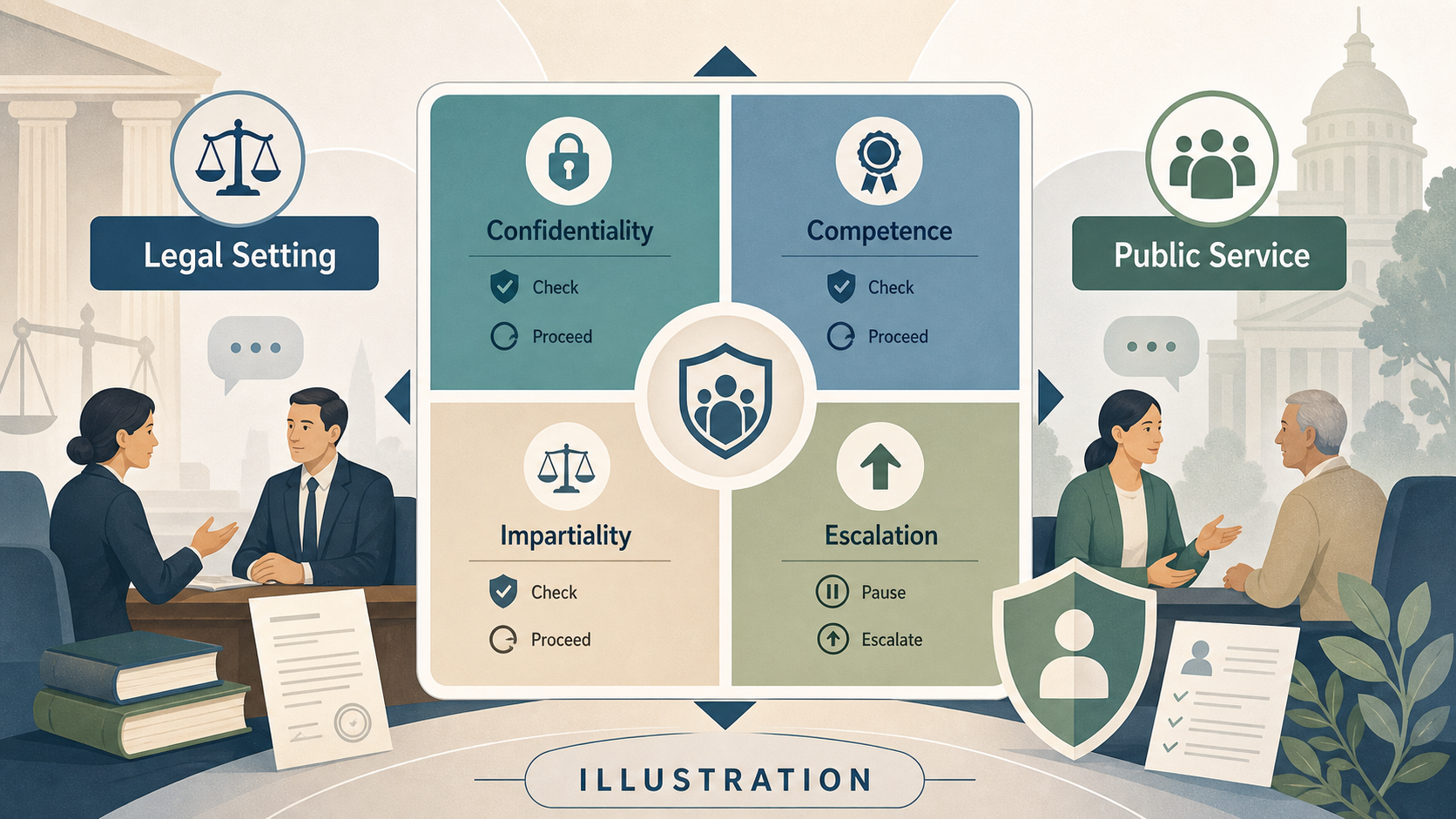 Regulated conversations need a more specific assessment because the setting can affect the competence required, the mode that is appropriate and the safeguards that the buyer must put around the assignment. ISO 20228:2019 establishes basic principles and practices for legal interpreting services, specifies competences of legal interpreters, describes legal settings and recommends corresponding interpreting modes. These are reasons to assess the assignment against its legal context rather than purchase it as a generic language request. ISO
The procurement team should identify the boundary of the assignment rather than asking a provider to make that judgement informally on the day. Is it a legal-service interaction? Does the discussion involve an interview, a hearing-related interaction, advice, an allegation or a decision with consequences for the participant? The guide cannot determine the legal classification for a buyer, but those questions flag when a specialist legal-interpreting assessment may be needed.
Professional conduct is also an operational control, not a slogan in a contract. The UK Visas and Immigration guidance sets out roles, responsibilities and professional standards for interpreters and translators working on its assignments, and includes disciplinary and misconduct material. Its existence illustrates why a buyer should ask how conduct expectations are communicated, monitored and escalated for sensitive assignments. GOV.UK
Do not promise that a delivery model removes all risk. Remote participation can introduce practical dependencies such as the quality of the connection, the meeting host’s controls and the ability of each participant to access the agreed channel. In-room delivery can still require clear preparation, privacy arrangements and a route for handling problems. The right procurement response is to allocate responsibilities and state the action to take when the planned arrangement is no longer suitable.
Some safeguards remain buyer-controlled. The organisation can decide who may attend, which materials are shared in advance, whether an assignment should proceed after a material change, and who has authority to pause or escalate. Providers can supply evidence and operate agreed processes, but the commissioning organisation should retain ownership of the meeting’s purpose, participant management and decision-making.
Provider Due Diligence and Evidence Requests
Use the supplier questionnaire to obtain evidence that can be checked against the assignment profile. For legal-service work, request an explanation of how the provider assesses whether the requested interpreter competence and interpreting mode fit the identified legal setting. ISO 20228:2019 is a relevant primary-source benchmark because it covers legal interpreting principles, competences, settings and mode recommendations. ISO
Ask prospective providers to describe their assignment-governance process in plain language. The answer should identify the information required at booking, who reviews higher-risk requests, how a proposed interpreter is matched to the requirement, and what happens if the planned resource becomes unavailable. Request the process description and, within appropriate confidentiality limits, the records or examples of evidence the provider can provide.
For conduct and incident handling, ask how professional expectations are set, how concerns are received, who decides the response, and how the customer is informed. UK Visas and Immigration’s interpreter guidance covers professional standards as well as disciplinary and misconduct matters for its context. A buyer can use that source to structure questions about equivalent governance without claiming that every provider operates the Home Office model. GOV.UK
For hybrid and public-service access, request a delivery explanation rather than only a platform list. NHS England’s framework is aimed at consistent, high-quality community-language translation and interpreting services for people with limited English proficiency. Ask how the provider records language need, confirms the chosen delivery arrangement, supports booking contacts and captures failures that affect access. NHS England
Score evidence separately from commercial terms. A supplier may offer an attractive price but provide an incomplete answer on assignment assessment, conduct governance or hybrid delivery controls. Mark the gap explicitly, ask a follow-up question and document whether the residual risk is acceptable for the use case.
A Selection Framework for Service Fit
Apply the same four-part assessment to every use case: meeting type, language and communication need, regulatory sensitivity, and delivery model. The first two establish the access requirement; the third determines whether a more specialised competence and control assessment is necessary; the fourth turns that requirement into a workable arrangement across rooms, platforms and locations.
First, classify the meeting. A routine internal discussion, a public-service appointment and a legal-service interaction should not automatically receive the same specification. ISO 20228:2019 is applicable to parties facilitating communication for users of legal services and specifically addresses legal interpreting competence, settings and modes. Where that boundary is engaged, record why the selected provider evidence and delivery mode are appropriate to it. ISO
Second, record the language need as a service requirement. NHS England’s framework supports provision for people with limited English proficiency; that supports an access-focused assessment rather than an assumption that participants will adapt to the meeting’s default language. Confirm the spoken or signed language need, the participants who rely on it, and any communication constraints that affect the proposed arrangement. NHS England
Third, assess the delivery model. State whether the meeting is virtual, in-room or hybrid; identify every participant location; define the audio and platform owner; and set the booking, preparation and contingency controls. If the model changes, require a re-check rather than treating an in-room booking as automatically suitable for a remote or mixed arrangement.
Fourth, assess governance evidence. The GOV.UK guidance demonstrates that interpreter roles, responsibilities and professional standards can be articulated alongside arrangements for disciplinary and misconduct matters. Use comparable questions to determine whether a provider can explain its own conduct and escalation controls. GOV.UK
Keep an auditable decision record. It should show the assignment profile, supplier evidence reviewed, scoring rationale, approved delivery mode, residual risks, decision-maker and review date. This makes later contract management more focused: the team can check whether the agreed controls were delivered rather than reconstructing the original rationale from email threads.
Contracting, Onboarding and Service Governance
Put the selected model into a service schedule before go-live. Define the minimum information for a booking; any lead-time or preparation expectations agreed with the supplier; the meeting host’s responsibilities; the interpreter’s access route; confidentiality handling; cancellation or change notifications; and the escalation contact on both sides. The contract should reflect the actual delivery modes that were evaluated, including hybrid arrangements where relevant.
For assignments involving legal services, include a control for confirming service fit when the setting or requested mode changes. ISO 20228:2019 covers legal settings, interpreter competences and mode recommendations, so the buyer has a sound basis for requiring a documented reassessment trigger rather than assuming an original booking remains appropriate after a material change. ISO
For conduct-related concerns, agree a route that is understandable to meeting owners and participants. UK Visas and Immigration’s guidance describes professional standards and disciplinary and misconduct material in the context of its interpreter arrangements. A supplier contract need not reproduce that guidance, but it should identify how concerns are raised, acknowledged, investigated and reported back within the parties’ agreed responsibilities. GOV.UK
Onboarding should test the operational hand-off. Run a controlled booking through the agreed path, confirm the contact roles, and verify that a hybrid meeting owner understands the platform and room responsibilities. Use findings to correct instructions before relying on the process for a high-consequence assignment.
Review the service against the original fit criteria. NHS England’s framework is concerned with consistent, high-quality interpreting provision for people with limited English proficiency; this supports reviewing whether access arrangements are working consistently, not only whether bookings were filled. Track issues by meeting type and delivery model, review material incidents with the provider, and revise the schedule when evidence shows that the approved model is no longer suitable. NHS England
Frequently Asked Questions
When is remote interpreting suitable for a hybrid meeting?
Remote interpreting may be suitable when the buyer can define a workable participant, platform and audio arrangement and the provider can deliver within it. The procurement record should state who joins remotely, how the interpreter receives access, who owns the meeting controls and what happens if the planned channel fails. For people with limited English proficiency, assess the arrangement as an access service, consistent with the purpose of NHS England’s improvement framework, rather than assuming that a remote invitation alone creates usable access. NHS England
How should legal interpreting requirements affect a supplier evaluation?
Treat the legal setting as a separate assessment factor. ISO 20228:2019 addresses legal interpreting principles, practices, interpreter competences, legal settings and interpreting modes, and applies to parties facilitating communication for users of legal services. Ask the provider to explain how it assesses competence and delivery-mode fit for the identified setting, then record the rationale and any unresolved risk. ISO
What professional conduct expectations should procurement teams address?
Address the conduct process as well as the expected standard. UK Visas and Immigration’s guidance sets out roles, responsibilities and professional standards for interpreters and translators in its assignments and includes disciplinary and misconduct material. Use that as a prompt to request a provider’s own expectations, reporting route, escalation process and customer communications; do not assume the provider follows the Home Office arrangements unless it supplies evidence that it does. GOV.UK
How can a public-service buyer support participants with limited English proficiency?
Build language access into the service design from the start: capture language need at booking, plan the delivery mode and participant access route, identify a responsible meeting owner and review failures that affect participation. NHS England’s framework is designed to support consistent, high-quality community-language translation and interpreting services for people with limited English proficiency, which supports this evidence-led, access-focused approach. NHS England
A procurement team does not need to make every assignment complex. It does need a repeatable way to recognise when meeting design, access need or regulatory sensitivity requires more than a generic booking. A documented fit assessment, evidence-based supplier questions and clear governance controls make that decision easier to defend and improve over time.
Related reading
- Business Services Provider Evaluation
- Remote interpreting vs on-site interpreting: which service model fits your organisation?
- Best corporate language training provider models for UK employers
- How to reduce business language-service spend without weakening quality controls
Editorial information: About our editorial team · Read our editorial policy · Read our affiliate disclosure.