A defensible provider decision starts with the service need—not with a price comparison. For UK procurement teams assessing language or wider business-services providers, the most reliable approach is to evaluate delivery capability, conduct, commercial risk and post-award governance as connected questions. The aim is to select a proposal that can deliver the required outcomes under realistic operating conditions and remain manageable throughout the contract.
Define the Evaluation Scope
Before inviting or comparing proposals, define the service problem in terms that can be evaluated. Set out the intended outcomes, users, operating locations, volumes, service constraints, quality expectations and any safeguarding, information-handling or accessibility needs. For language services, this might include language combinations, turnaround times, interpreting channels, escalation arrangements and the consequences of an incorrect or delayed service.
The Sourcing Playbook places delivery-model assessment, market engagement, due diligence, bid evaluation and transition within one sourcing lifecycle. Use that perspective to decide what evidence is proportionate for this procurement. A low-risk, standard service may need a focused comparison; a complex, public-facing or business-critical service should test mobilisation, continuity and governance in greater depth.
Write the evaluation scope before finalising criteria. It should identify which outcomes are non-negotiable, where supplier flexibility is useful, and which assumptions the team must verify. This gives evaluators a common basis for assessing submissions and helps ensure that questions asked of providers relate directly to the proposed service.
Further reading: procurement requirements definition guide.
Use a Balanced Provider Evaluation Framework
A balanced framework prevents one attractive feature—such as a low headline price, a polished presentation or a familiar brand—from carrying the decision. Assess each provider across five connected dimensions:
- delivery capability and service design;
- conduct, transparency and relationship readiness;
- commercial risk allocation and pricing assumptions;
- financial resilience and continuity arrangements; and
- governance, performance management and transition planning.
The Sourcing Playbook covers due diligence during selection, evaluating bids, ongoing financial monitoring, successful relationships, and transition or termination. Its structure is a useful reminder that suitability is more than a response to a written specification. The Supplier Code of Conduct adds expectations around employees and service users, business practices and standards of behaviour. Risk-allocation guidance explains why disproportionate or inappropriate allocation can contribute to contract underperformance or failure.
Translate these themes into a small number of weighted criteria and evidence requests. Weighting should reflect the risk and importance of the service, rather than using a standard split by habit. Keep the framework visible to bidders so they understand the decision logic and can address the evidence required.
Further reading: public procurement evaluation criteria.
Assess Delivery Capability and Service Design
AI-generated generic editorial illustration — not a retailer product photo and does not depict the reviewed product or service. Give readers a scannable framework for assessing whether a provider can deliver the proposed service model.
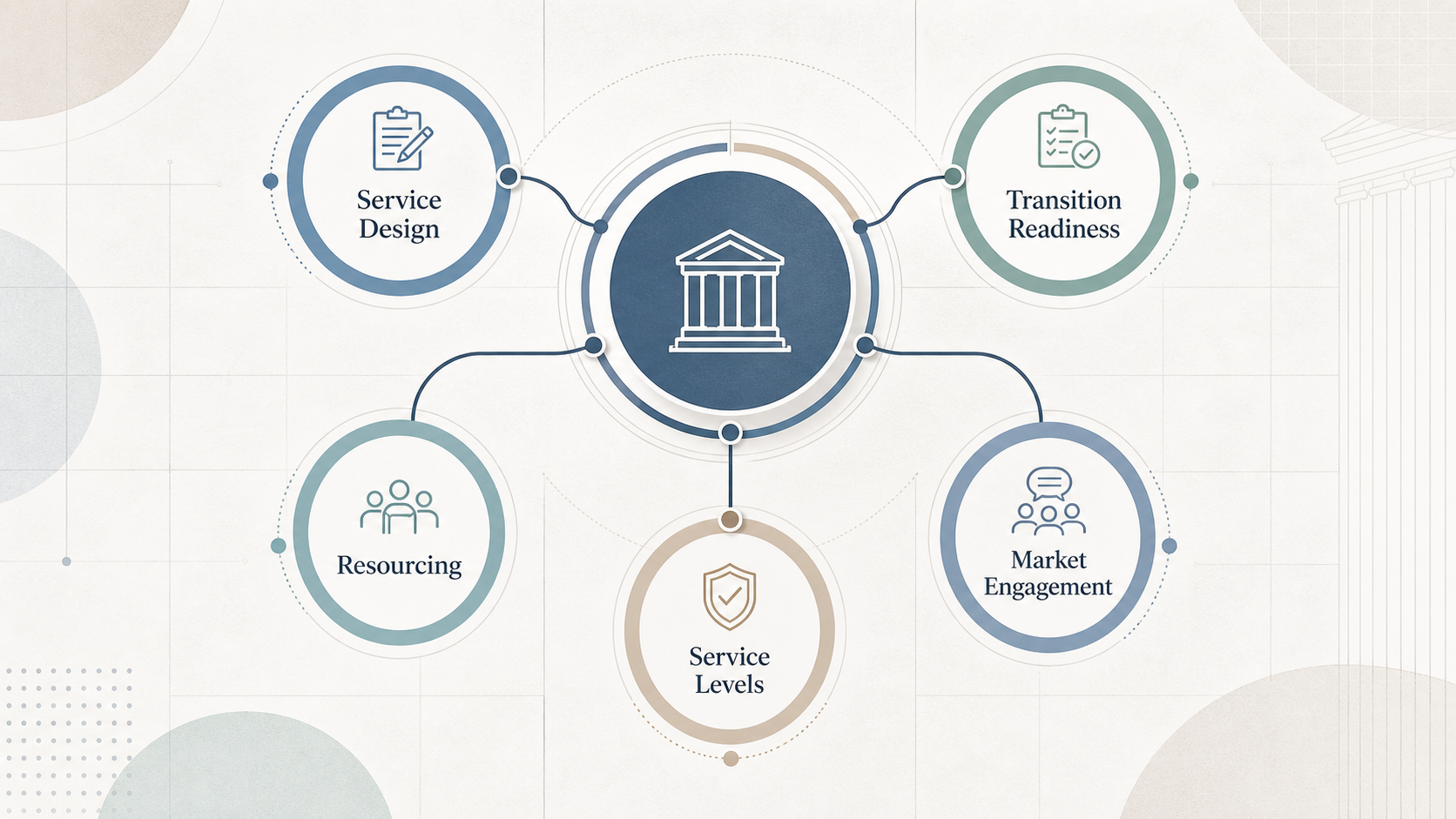 Ask providers to demonstrate how their operating model will deliver the required outcomes in the actual service environment. A credible answer explains the service journey, accountabilities, staffing model, controls, performance measures and escalation routes. It should distinguish commitments from assumptions, and identify dependencies on the authority, subcontractors, technology or third parties.
Test whether the proposed design is workable at mobilisation as well as at steady state. Request evidence of implementation planning, knowledge transfer, recruitment or capacity plans, system configuration, training, contingency cover and acceptance criteria. Where providers rely on a transition period, assess the milestones, ownership, data requirements and fallback arrangements rather than treating the timetable as a simple promise.
For language and business services, examine how the provider will maintain suitable capacity while meeting quality, security and response-time expectations. Probe how it will manage peaks in demand, absence, specialist requirements, complaints and service recovery. Market engagement and due diligence are part of the Sourcing Playbook’s lifecycle; use clarifications to test gaps or unclear dependencies consistently across bidders.
A practical evaluation question is: what observable evidence would show that this service design can work on day one and during disruption? Score the evidence, not the confidence of the presentation.
Further reading: service delivery due-diligence checklist.
Evaluate Supplier Conduct and Relationship Readiness
Provider behaviour affects delivery quality, especially where services involve vulnerable users, sensitive information, subcontracted work or frequent operational contact. The Government’s Supplier Code of Conduct describes expectations relating to employees and service users, business practices, and standards of behaviour. These expectations can inform proportionate questions about ethics, fair treatment, transparency and responsible supply-chain management.
Ask providers how they will communicate issues, report performance, handle complaints and share information needed for oversight. Look for clear accountability, realistic commitments and a willingness to discuss limitations early. A provider’s approach to change control, dispute resolution and corrective action can be as informative as a generic statement of collaboration.
Conduct should not be assessed as an isolated policy check. Connect it to the service model: for example, assess whether the proposed workforce arrangements support safe, respectful and reliable service; whether subcontractor governance is clear; and whether the provider can work openly with the authority when performance deteriorates.
Use published criteria and a consistent evidence request for all bidders. This keeps relationship readiness relevant to the contract while avoiding subjective judgments based on presentation style.
Further reading: supplier code of conduct explained.
Test Risk Allocation, Pricing and Financial Resilience
AI-generated generic editorial illustration — not a retailer product photo and does not depict the reviewed product or service. Show how commercial risk, pricing assumptions and financial resilience should be tested together during evaluation.
 Price is one element of value, not proof that a proposal is viable. Review pricing together with risk ownership, payment mechanisms, assumptions, inflation exposure and the provider’s ability to sustain delivery. The Government’s risk-allocation guidance states that inappropriate or disproportionate allocation is widely recognised as a reason contracts can underperform or fail.
Start with a risk register that identifies the material delivery, demand, workforce, technology, data, transition and market risks. For each risk, determine who can best manage it, what controls are proposed, what evidence supports the approach, and how the consequences will be handled if the risk occurs. Do not assume that transferring a risk to the supplier removes it from the authority’s responsibility to monitor the outcome.
Examine how the price was constructed. Ask what volumes, productivity levels, staffing assumptions, indexation arrangements, service credits, change mechanisms and exclusions underpin it. A low-price bid may be credible, but it needs an explanation that remains consistent with its delivery model and risk position. Clarify material ambiguities through the published procurement process and apply the same approach to comparable bidders.
Financial resilience is also a continuing issue. The Sourcing Playbook includes resolution planning and ongoing financial monitoring, indicating that a contract’s exposure should be considered beyond award. Set proportionate checks for the provider and, where relevant, critical subcontractors; then document what would trigger escalation, additional assurance or contingency action.
Further reading: contract risk allocation guide and supplier financial due diligence.
Score Providers Against Clear Evidence
Create an evaluation plan that links every score to disclosed criteria, a scoring scale and identifiable evidence. Define what a strong, adequate and weak response looks like before assessment begins. This reduces the chance that evaluators apply different standards or substitute personal preference for the stated requirements.
Use weighted criteria only where the weights reflect the importance and risk of the service. Assess written submissions, demonstrations, clarifications and due-diligence findings against the same recorded framework. Keep a clear separation between evidence submitted by a provider, clarification sought during the process, evaluator observations and the moderation decision.
Moderation should resolve genuine differences by returning to the criterion and evidence, not by averaging opinions without explanation. Record the rationale for each final score, material clarifications, assumptions accepted or rejected, and any risks that need to become contractual controls. The Sourcing Playbook’s coverage of bid evaluation and contract award supports this evidence-led, documented approach.
An auditable record protects both decision quality and fairness. It also creates a useful handover: contract managers can see which provider commitments, dependencies and risks were considered material at award.
Further reading: bid evaluation scoring template.
Plan Governance Beyond Contract Award
Selection should test whether the proposed relationship can be governed after award. Agree the mobilisation plan, reporting rhythm, performance measures, meeting structure, escalation paths and decision rights before the contract starts. Define which service measures indicate outcomes, not only activity, and how performance data will be checked.
The Sourcing Playbook includes ongoing financial monitoring, successful relationships, and expiry, extension, transition and termination. Build these considerations into the initial governance design. For example, specify how risks are reviewed, how corrective plans are approved, how service changes are controlled and when continuity or exit arrangements must be refreshed.
The Supplier Code of Conduct frames the relationship as one based on trust, with fair and transparent dealings expected on both sides. Put that principle into operational practice through timely issue reporting, documented actions and clear ownership. Good governance does not eliminate problems; it makes them visible early enough to manage.
Further reading: supplier performance management guide.
Frequently Asked Questions
What evidence should a business-services provider submit during evaluation?
Request evidence that maps directly to the criteria: a service design, staffing and capacity approach, transition plan, quality controls, performance measures, risk register, pricing assumptions, subcontractor arrangements and governance model. The appropriate depth depends on service risk and complexity. The Sourcing Playbook supports using due diligence, market engagement and bid evaluation as connected parts of the sourcing process, so evidence should be tested for consistency rather than accepted as separate assurances.
How should a procurement team assess a low-price proposal with significant supplier-held risk?
Review the price with the delivery model and risk allocation. Ask which assumptions make the price possible, who controls the relevant risks, how inflation and changes are handled, and what happens if volumes or dependencies differ from plan. The Government’s risk-allocation guidance warns that disproportionate allocation can contribute to poor outcomes. A low price is not automatically unsuitable, but the team should document why the proposal is credible and what controls are needed.
When should financial resilience and resolution planning be considered?
Consider them during selection and keep them under review throughout the contract where the exposure is material. The Sourcing Playbook expressly includes resolution planning and ongoing financial monitoring. The level of scrutiny should be proportionate to the authority’s reliance on the provider, the criticality of the service, and the availability of realistic alternatives or continuity arrangements.
How can the team evaluate supplier conduct alongside service capability?
Use disclosed, evidence-based questions on treatment of employees and service users, business practices, transparency, subcontractor oversight and problem handling. The Supplier Code of Conduct provides a relevant public-sector reference point. Then connect the responses to the operating model: assess whether the provider’s stated practices support reliable delivery, open reporting and a workable relationship when issues arise.
Further reading: procurement provider selection FAQ.
Sources
- The Sourcing Playbook, Cabinet Office
- Supplier Code of Conduct, Government Commercial Function
- Risk Allocation and Pricing Approaches guidance note, Cabinet Office
Related reading
- How to choose a business translation service for UK regulated teams
- How to procure interpreting services for hybrid meetings and regulated conversations
- Translation agency vs language-AI platform: procurement trade-offs for UK teams
- Best business translation service models for UK procurement teams
Editorial information: About our editorial team · Read our editorial policy · Read our affiliate disclosure.