For UK procurement teams, the useful question is not which interpreting channel is best in the abstract. It is which model can meet the requirements of a particular assignment with appropriate competence, conduct, accessibility, confidentiality and continuity controls. NHS England’s 2025 improvement framework is intended to support consistent, high-quality community-language translation and interpreting services, while UK Visas and Immigration’s interpreter code of conduct sets out professional standards for interpreters working across operationally varied assignments. [ev_763200ce25d7ee3b] [ev_d69900f0ebda842a]
Verdict: Match the Model to the Assignment
Neither remote nor on-site interpreting is universally superior. The appropriate route depends on the nature of the conversation, the setting, the language required, privacy and safeguarding needs, the technology available, and the organisation’s ability to keep the service running if circumstances change. [ev_763200ce25d7ee3b] [ev_d69900f0ebda842a]
Treat the decision as a documented assignment-fit exercise. Compare remote, on-site and blended provision against the service requirements rather than choosing a channel by habit. In practice, that means testing the delivery model alongside the interpreter’s competence, professional expectations, booking process, accessibility arrangements and escalation route. Language-service standards exist to set basic requirements and quality expectations, so buyers should make those requirements explicit in the specification rather than assuming that either channel assures quality by itself. [ev_4dee3c7576fb3d77]
A blended, assignment-led contract is often the most adaptable starting point: it can use secure remote delivery where it meets the brief and define clear criteria for in-person escalation where it does not.
Remote and On-site Interpreting: The Operating Models
AI-generated generic editorial illustration — not a retailer product photo and does not depict the reviewed product or service. Make the two operating models immediately comparable before assessing assignment fit.
 Remote interpreting is delivered without the interpreter attending the location. It may use telephone, video or a scheduled digital session. On-site interpreting involves the interpreter attending in person at the relevant venue. These definitions describe how the service is delivered; they do not, on their own, establish whether it is suitable for a given assignment.
The procurement comparison should therefore be broader than a remote-versus-in-person choice. Ask how the supplier will identify and allocate an appropriate interpreter, confirm language needs, protect confidential information, support accessible participation, manage bookings and deal with disruption. The NHS framework’s focus on consistent, high-quality community-language services supports treating these as service-design questions, not merely technology choices. [ev_763200ce25d7ee3b]
The same principle applies to professional practice. The Association of Translation Companies explains that language-services standards are intended to define basic requirements and quality expectations and offer criteria for objectively assuring professionalism. [ev_4dee3c7576fb3d77] A procurement team can therefore require evidence of governance and delivery controls for either operating model.
Where Remote Interpreting Is Strongest
Remote delivery can be a strong fit when the assignment can be conducted securely through an appropriate audio or video connection and when rapid access to the required language matters. It can also be valuable where participants or service locations are geographically dispersed, or where travel would make arranging in-person attendance operationally difficult.
Its practical advantage is flexibility: a supplier may be better placed to organise a suitable remote interpreter across a wider operating area than to arrange physical attendance at short notice. That potential should be tested against the provider’s actual booking, matching and continuity process, rather than treated as an automatic result of using technology.
Procurement requirements should cover the conditions under which remote sessions will be offered. Define the expected booking route, required audio or video capability, participant support, confidentiality arrangements and the path for moving to another model if the session is not suitable. NHS England’s framework is specifically designed to support consistent, high-quality community-language translation and interpreting services; consistency should be reflected in the service controls around the remote route. [ev_763200ce25d7ee3b]
Remote delivery should also be subject to the same professional expectations as other interpreting services. The channel does not remove the need for an appropriately qualified and well-governed service. Standards for the language-services industry are intended to establish quality expectations and objectively assess professionalism, which gives buyers a reason to seek evidence rather than rely on channel-based assumptions. [ev_4dee3c7576fb3d77]
Remote Interpreting: Limitations and Controls
Remote sessions depend on a workable technical and participant environment. Before relying on them, assess access to a suitable device, connectivity, sound and image quality where video is used, and whether participants can confidently use the chosen format. A delivery method that is technically available may still be unsuitable if it prevents participants from communicating effectively.
Privacy and safeguarding require an assignment-specific check. Confirm who will be present at each end of the session, whether the setting permits a confidential conversation, how the connection will be initiated, and how concerns can be escalated. For conversations with heightened sensitivity or communication complexity, require a documented decision on whether remote delivery remains appropriate rather than leaving the choice to convenience alone. NHS England’s framework supports a consistent, high-quality approach to community-language services, which is best achieved through explicit assessment and controls. [ev_763200ce25d7ee3b]
Set out a failure plan in the contract. It should state what happens if connectivity fails, a participant cannot use the technology, privacy is compromised, or the interpreter concludes that the assignment cannot safely continue in its current format. The plan may include reconnection, rescheduling, a different remote method or escalation to an on-site booking, but the trigger and ownership should be clear.
Where On-site Interpreting Is Strongest
In-person attendance can be a strong fit where physical presence materially supports the assignment. Examples may include situations in which the interpreter needs to understand the site context, coordinate with people present in the room, or support a conversation whose sensitivity or interaction demands warrant a face-to-face delivery assessment. This is an assignment-fit consideration, not a presumption that attendance is always better.
On-site provision may also make practical sense where secure remote participation cannot be arranged or where participants cannot reasonably access or use the required technology. The decision should still account for interpreter availability, the required language, travel arrangements and continuity.
Attendance does not replace governance. UK Visas and Immigration’s interpreter code of conduct describes the role, responsibilities and professional standards expected of freelance interpreters delivering assignments across UK locations and operational demands. [ev_d69900f0ebda842a] Buyers should translate the same themes into their own requirements: clear conduct expectations, confidentiality controls, appropriate assignment information and a way to raise or investigate concerns.
The language-services standards described by the ATC reinforce the point that professionalism should be objectively evidenced through requirements and quality expectations, not inferred from the fact that an interpreter is present in the room. [ev_4dee3c7576fb3d77]
On-site Interpreting: Limitations and Controls
On-site delivery introduces dependencies that should be visible in the procurement model: travel, local availability, booking lead time, venue access and the effect of disruption on attendance. These factors can make a physical attendance requirement harder to fulfil for some languages, locations or times of day.
Specify the operational controls in advance. The agreement should explain lead times, how urgent bookings are handled, when a replacement will be sought, who communicates changes, and what evidence will be reported when an assignment cannot be covered as requested. Include transparent charging rules so that travel, waiting time, cancellation and short-notice arrangements can be assessed alongside the core service price.
Do not confuse a preference for in-person delivery with a hard operational requirement. The buyer should be able to state why attendance is necessary for the assignment and whether a secure remote alternative is acceptable if the original route becomes unavailable. UKVI’s code recognises that interpreting services are delivered across locations and in response to operational demands that may arise at any time, illustrating why clear booking and conduct arrangements matter. [ev_d69900f0ebda842a]
Remote vs On-site Interpreting: Decision Matrix
AI-generated generic editorial illustration — not a retailer product photo and does not depict the reviewed product or service. Give procurement teams a scannable visual framework for selecting a service model by assignment conditions.
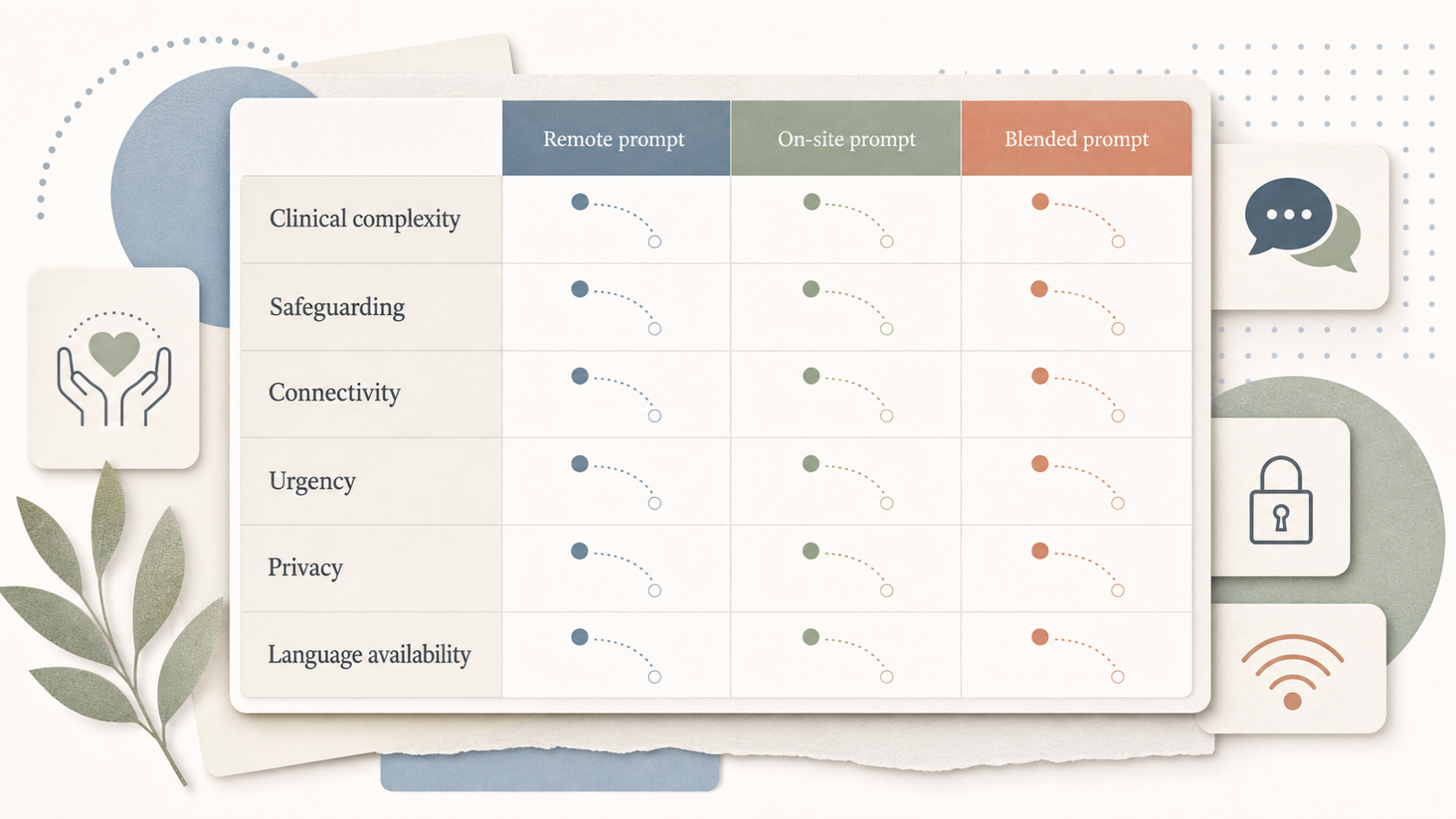 Use the following matrix as a set of procurement prompts, not as a universal scoring rule.
| Assignment factor | Remote may fit when | On-site may fit when | Buyer control |
|---|---|---|---|
| Communication complexity | Participants can communicate effectively through the agreed channel | The setting or interaction needs physical presence | Record the rationale and reassess if conditions change |
| Sensitivity, privacy and safeguarding | A confidential, controlled remote environment can be confirmed | The remote environment cannot be made sufficiently controlled | Define privacy checks, escalation and incident handling |
| Language availability and urgency | Suitable remote coverage can be arranged quickly | Physical attendance is required and available within the needed timeframe | Require booking, matching and replacement service levels |
| Location and access | Travel or dispersed locations make attendance difficult | The location itself is important to understanding the assignment | Confirm venue access and travel arrangements |
| Technology readiness | Devices, connectivity and participant support are adequate | Technology is unavailable, unreliable or inaccessible | Test the connection and keep a documented fallback route |
| Continuity | An alternative remote route can be activated | A named or replacement in-person arrangement is required | Define failure, replacement and communication processes |
| Cost structure | Charges and delivery controls are transparent | Attendance-related charges are justified and transparent | Compare total cost with quality, service levels and contingencies |
The matrix should sit within a wider quality framework. NHS England’s guidance is aimed at consistent, high-quality community-language services; the ATC notes that language-services standards establish quality expectations and criteria for objective assurance; and the UKVI code describes professional roles and standards. [ev_763200ce25d7ee3b] [ev_4dee3c7576fb3d77] [ev_d69900f0ebda842a]
Price is only one input. A lower quoted route may be a poor value decision if it lacks the interpreter competence, confidentiality safeguards, accessibility support, booking response or contingency arrangements that the assignment needs. Conversely, an on-site requirement should not be retained solely because it is familiar when a secure, well-governed remote route meets the documented brief.
Alternatives: Blended and Assignment-led Provision
A binary choice can create unnecessary rigidity. A blended model allows the organisation to support both remote and on-site delivery under one governance framework, with the route selected through assignment triage. That approach can preserve flexibility while keeping professional standards, confidentiality and service expectations consistent.
One practical model is to make remote delivery an available route, not an automatic default, and to define on-site escalation criteria in the contract. Criteria might cover the need for physical attendance, inability to establish a secure technical environment, participant accessibility needs, or a level of communication complexity that the buyer has decided requires a different arrangement. Each criterion should be documented and reviewable.
Before broad adoption, test the approach against representative assignments. Include planned and urgent work, different language requirements, sensitive conversations, multiple locations and a simulated technology or availability failure. The NHS framework’s emphasis on consistent, high-quality services supports using evidence from these tests to refine the operating model. [ev_763200ce25d7ee3b]
A framework agreement can then offer more than one delivery route without forcing every service user into the same one. The key is an accountable triage process and clear escalation ownership.
Procurement Checklist for Choosing a Service Model
Before award, confirm that the specification and evaluation process cover:
- The assignment types, languages, locations, hours and expected demand that the service must cover.
- Interpreter competence, conduct and professional expectations, with evidence the supplier can provide. UKVI’s code of conduct demonstrates the value of clearly stated interpreter roles, responsibilities and professional standards. [ev_d69900f0ebda842a]
- Confidentiality, privacy, safeguarding and incident-escalation arrangements for both remote and on-site work.
- Accessibility and participant-support requirements, including the conditions for using technology.
- Booking channels, lead times, urgent-assignment handling, matching, replacement and cancellation processes.
- Remote technical requirements, pre-session checks, support arrangements and a documented failure contingency.
- On-site venue, travel, access, disruption and cost-transparency requirements.
- Service-level reporting, complaints handling, quality review and an agreed route for improving the model.
- A recorded assignment-triage method that explains when remote, on-site or blended delivery is selected.
The aim is not to impose a single standardised route on every assignment. It is to create consistent, reviewable governance around a model that can be adapted when conditions change. NHS England’s improvement framework, the UKVI conduct guidance and the ATC’s discussion of quality standards all support an explicit approach to service quality and professionalism. [ev_763200ce25d7ee3b] [ev_d69900f0ebda842a] [ev_4dee3c7576fb3d77]
Use supplier evaluation to test evidence, not promises. Ask providers to demonstrate how they allocate interpreters, protect confidential conversations, address service failures and report performance across both delivery routes.
Frequently Asked Questions
Is remote interpreting suitable for sensitive conversations?
It can be suitable only where the specific assignment can be delivered in a confidential, controlled environment and participants can communicate effectively through the chosen format. Assess privacy, safeguarding, accessibility, technical reliability and escalation arrangements in advance. If those conditions cannot be met, use an alternative route. [ev_763200ce25d7ee3b]
When should we require an on-site interpreter?
Require on-site attendance when the documented assignment needs physical presence, site context or an in-person environment that cannot reasonably be replicated through secure remote delivery. Record why attendance is needed, check availability and define the replacement process. Attendance should not substitute for competence, conduct or confidentiality controls. [ev_d69900f0ebda842a] [ev_4dee3c7576fb3d77]
Can one contract support both remote and on-site interpreting?
Yes. A blended contract can offer both routes if it defines assignment triage, booking processes, service levels, privacy controls, pricing and escalation criteria for each. Test the model against representative assignments before extending it across the organisation. [ev_763200ce25d7ee3b]
What quality and conduct controls should we ask a supplier to evidence?
Ask for evidence of interpreter competence and conduct expectations, confidential-information handling, assignment matching, booking and replacement processes, incident escalation, service reporting and quality review. Relevant UK guidance sets out professional standards for interpreters, and language-services standards are designed to establish quality expectations and objective assurance criteria. [ev_d69900f0ebda842a] [ev_4dee3c7576fb3d77]
[Primary CTA: Request an assignment-fit interpreting service assessment]
Sources
Related reading
- How to procure interpreting services for hybrid meetings and regulated conversations
- Translation agency vs language-AI platform: procurement trade-offs for UK teams
- Best corporate language training provider models for UK employers
- How to reduce business language-service spend without weakening quality controls
Editorial information: About our editorial team · Read our editorial policy · Read our affiliate disclosure.