Translation agency vs language-AI platform: the procurement verdict
For UK procurement teams, the right choice is usually a workflow decision, not a universal quality ranking. Choose a translation agency when the assignment needs accountable human delivery, specialist terminology controls, a managed project process or documented assurance against demanding specifications. Choose a language-AI platform when high volume, rapid turnaround, repeatable digital content and self-service collaboration matter more than a fully managed service. [Source: ev_dda07503ab32bb67; ev_44d41bb78c2ee846]
For many organisations, the most workable answer is a governed hybrid. Route low-risk, high-volume material through an approved technology workflow; reserve agency delivery or qualified human review for customer-facing, contractual, regulated, safety-sensitive or brand-critical content. The selection rule is simple: match the delivery model to the consequences of an error, the required accountability and the scale of the workflow. [Source: ev_dda07503ab32bb67; ev_44d41bb78c2ee846]
What each model actually buys
AI-generated generic editorial illustration — not a retailer product photo and does not depict the reviewed product or service. Make the two sourcing models comparable at a glance before the decision matrix.
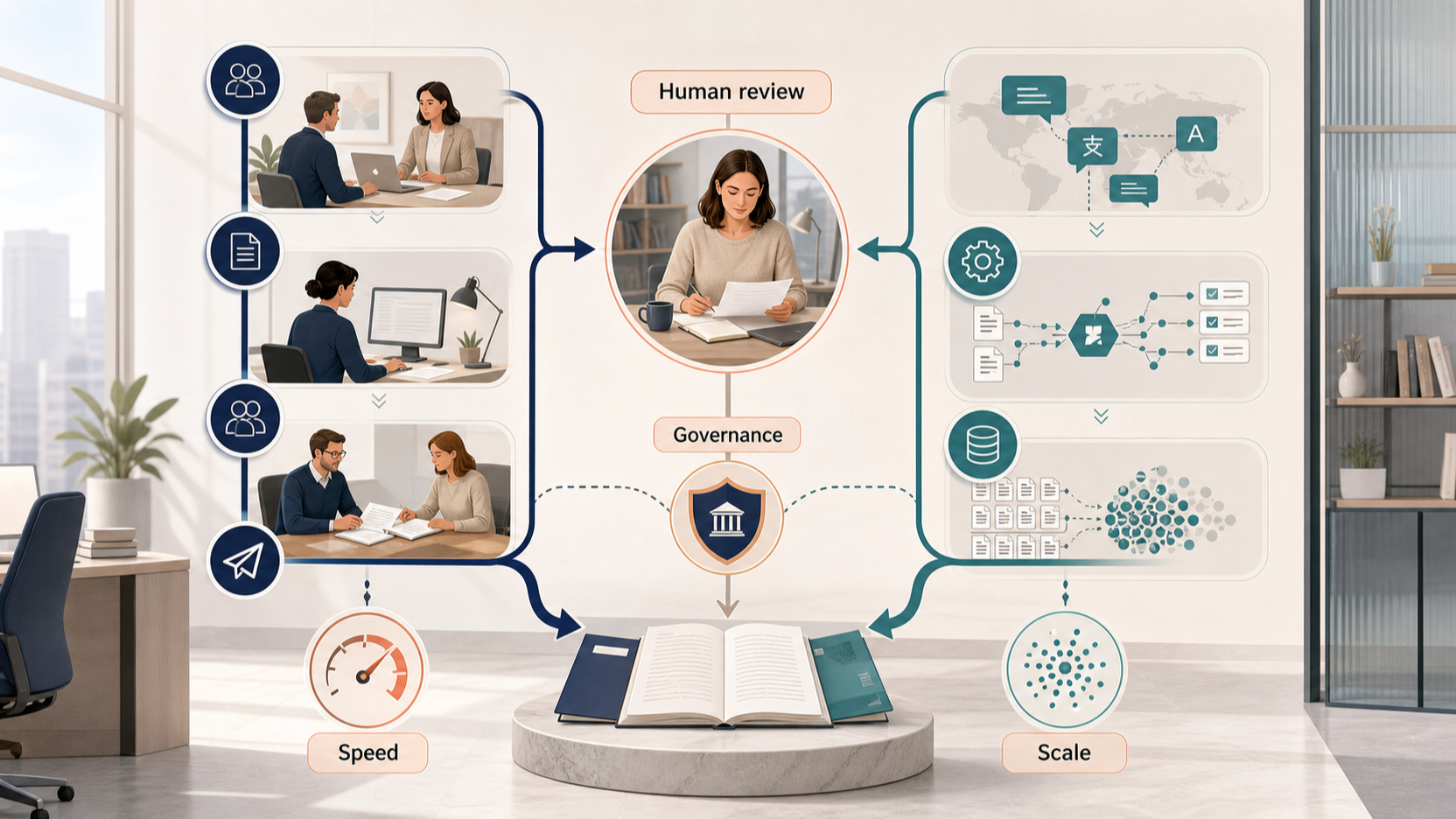 A translation agency is normally a managed language-service model. The buyer is procuring people, process and accountability together: resource selection, project coordination, translation delivery and the controls the provider applies to meet the agreed specification. ISO 17100 describes requirements for the core processes and resources used to deliver a translation service that meets applicable specifications. [Source: ev_dda07503ab32bb67]
A language-AI platform is a technology-led workflow. It may combine machine translation, automation, collaboration features, integrations and optional human review. Translation software is marketed to help businesses streamline communication with global audiences, but the practical service model can vary substantially between tools and suppliers. [Source: ev_44d41bb78c2ee846]
The labels overlap. An agency may use translation technology and offer technology-enabled workflows; a platform may add professional review or managed services. Procurement should therefore ask what happens to a document from source to acceptance: who translates or reviews it, who owns terminology, who approves changes, and who is accountable when the output fails the agreed standard. [Source: ev_dda07503ab32bb67; ev_44d41bb78c2ee846]
Where translation agencies are strongest
Agencies are strongest where the buyer needs a managed path from brief to accepted deliverable. That is often valuable for complex specifications, specialist subject matter, controlled terminology, multiple stakeholders or material where an error can create commercial, operational or reputational consequences. The managed model can provide a clear point of responsibility for resourcing, coordination, queries, delivery and remediation. [Source: ev_dda07503ab32bb67]
For a process-led baseline, ISO 17100 sets requirements covering the processes, resources and other aspects necessary to deliver a quality translation service against applicable specifications. It also provides a basis on which a translation service provider can demonstrate conformity for specified services. That makes it a useful due-diligence reference when a supplier proposes a human translation service, not a substitute for evaluating the provider’s actual people, workflow and evidence. [Source: ev_dda07503ab32bb67]
The Association of Translation Companies notes that language-services standards aim to establish baseline requirements and quality expectations, and that they can provide criteria for assessing language-service-provider professionalism. Procurement should still test the proposed language pairs, subject expertise, review path and escalation arrangements for the buyer’s own content. Not every agency is certified, and a standards reference alone does not guarantee a successful outcome. [Source: ev_4dee3c7576fb3d77; ev_dda07503ab32bb67]
Agency oversight is usually proportionate when acceptance criteria are exacting: for example, where terminology must remain controlled across releases, where a named reviewer is required, or where the buyer needs documented delivery accountability. [Source: ev_dda07503ab32bb67]
Where language-AI platforms are strongest
Language-AI platforms are strongest when speed, scale and repeatability create more value than a fully managed delivery model. They can help teams move large volumes of digital content through a common workflow, enable collaboration and support rapid access to translation capability. Translation software is positioned for businesses seeking to streamline communication with global audiences. [Source: ev_44d41bb78c2ee846]
The procurement advantage is not simply that the workflow uses AI. It is that the organisation may be able to connect translation to its existing content operations, route routine material quickly and apply a consistent process at high volume. The value proposition is most credible where content is structured, frequently updated, low consequence if delayed or corrected, and governed through clear use-case rules. [Source: ev_44d41bb78c2ee846]
Buyers should distinguish raw machine-translated output from a workflow that adds terminology controls, review or post-editing. Those are different operating models with different owners of quality. A platform can be a useful component of a controlled workflow, but procurement should define the review responsibility and acceptance threshold rather than assume that technology alone establishes suitability. [Source: ev_dda07503ab32bb67; ev_44d41bb78c2ee846]
Platforms therefore fit best where the volume and risk profile support them: internal knowledge content, routine product updates, drafts for controlled review, or repetitive multilingual material with a documented escalation route for exceptions. [Source: ev_44d41bb78c2ee846]
Limitations and risks to price into the decision
The agency model can carry higher unit costs and additional coordination time. Mobilisation, review and managed delivery may be justified for demanding work, but they should be tested against the business need rather than added by default. Quality can also vary by provider, language pair, subject area and the resources assigned, so procurement should evaluate the actual proposed service rather than the agency label. [Source: ev_dda07503ab32bb67; ev_4dee3c7576fb3d77]
The platform model shifts more governance responsibility to the buyer unless the supplier explicitly owns it. Risks can include inadequate context, inconsistent terminology, unclear approval ownership, unsuitable treatment of sensitive content and rework that is invisible in a low headline price. Controls should specify permitted content types, data handling, review thresholds, exception management and who may publish the resulting text. [Source: ev_dda07503ab32bb67]
A particularly important standards boundary is ISO 17100’s stated scope: raw machine-translation output plus post-editing is outside the scope of ISO 17100:2015. Procurement should not present an AI or post-editing workflow as automatically assured by that standard. Instead, request evidence for the specific workflow being offered and assess it against the organisation’s own acceptance criteria. [Source: ev_dda07503ab32bb67]
Decision matrix for UK procurement teams
Use the following matrix as a routing tool, then document the decision for each material workflow.
| Decision factor | Agency-led delivery is often the stronger fit | Language-AI platform is often the stronger fit |
|---|---|---|
| Content criticality | High-stakes, externally published or tightly specified material | Lower-risk, easily corrected or internally controlled material |
| Volume and update rate | Lower volume or work requiring managed coordination | High-volume, repetitive and frequently changing content |
| Turnaround | Time is available for managed production and review | Rapid, self-service throughput is a priority |
| Terminology | Specialist terminology needs accountable governance | Terminology can be controlled within an approved workflow |
| Accountability | A clear provider-owned delivery path is required | The buyer can own routing, approvals and exceptions |
| Integration needs | Managed hand-offs are sufficient | Translation needs to sit close to digital content operations |
| Total cost | Review and delivery assurance justify the cost | Scale can justify automation, subject to governance costs |
This matrix is a decision aid, not an assurance mechanism. ISO 17100 links service quality to applicable specifications, processes and resources; translation software can support streamlined global communication. Neither point establishes that a model is right for every use case. [Source: ev_dda07503ab32bb67; ev_44d41bb78c2ee846]
A hybrid pathway is often appropriate. Define an approved platform route for high-volume, lower-risk content, with terminology and publishing controls. Define an agency or qualified-review route for high-stakes material. Require each route to have documented content classifications, review ownership, escalation triggers and acceptance criteria. [Source: ev_dda07503ab32bb67]
Alternatives to a binary choice
An in-house localisation or multilingual-content team may be considered where an organisation has sustained multilingual demand and internal capability to manage prioritisation, terminology, supplier coordination and quality controls. Any specialist or exceptional work still requires a defined process. [Source: ev_44d41bb78c2ee846; ev_4dee3c7576fb3d77]
Specialised multilingual content providers may be considered where translation forms part of a wider content requirement, such as content adaptation, market input or a particular workflow. A hybrid managed-platform arrangement may combine technology with provider-operated review and escalation. In either case, assess the proposed process against the buyer’s applicable specifications. [Source: ev_dda07503ab32bb67; ev_4dee3c7576fb3d77]
Procurement teams should evaluate the proposed model against defined quality, compliance and operating requirements, including where human review and accountability are required by the risk assessment. [Source: ev_dda07503ab32bb67]
How to run a defensible supplier evaluation
AI-generated generic editorial illustration — not a retailer product photo and does not depict the reviewed product or service. Support a defensible, evidence-led supplier assessment process.
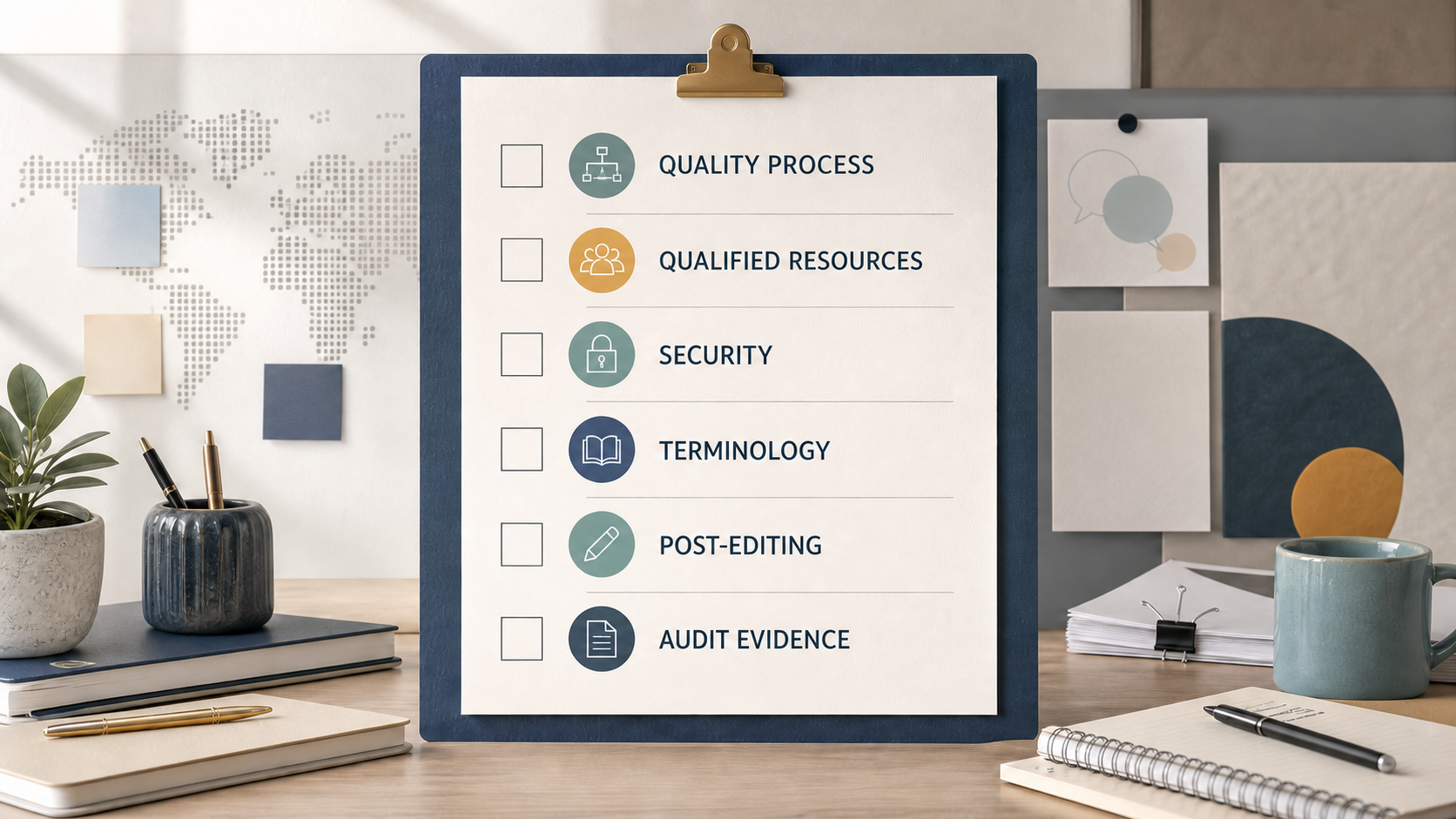 Start by classifying content by risk and consequence. Identify which material is customer-facing, legally significant, regulated, safety-sensitive, confidential or brand-critical; then define the required controls for each class. Translate those controls into measurable acceptance criteria before asking suppliers to quote. ISO 17100 explicitly frames translation services around applicable specifications and the processes and resources required to meet them. [Source: ev_dda07503ab32bb67]
Next, request workflow evidence rather than relying on feature lists or a standards reference. Ask each supplier to explain:
- who translates, reviews and gives final approval;
- how qualified resources, terminology and client instructions are managed;
- how data is handled and escalations are recorded;
- which content may use automation, and which requires human review;
- how auditability, revisions and remediation work; and
- which volume, language, integration and review assumptions sit behind the price.
Standards can provide useful assessment criteria for language-service providers, but supplier-specific verification remains necessary. [Source: ev_4dee3c7576fb3d77; ev_dda07503ab32bb67]
Finally, run a representative pilot. Include routine material, terminology-sensitive content and realistic edge cases; measure accuracy against agreed acceptance criteria, turnaround, exception handling, review effort and rework. Compare total cost of ownership, not only unit price. For AI-enabled workflows, make the workflow boundary explicit: ISO 17100 does not include raw machine-translation output plus post-editing within its scope. [Source: ev_dda07503ab32bb67]
{{primary_cta}}
Frequently Asked Questions
Can a language-AI platform be used for regulated or high-stakes content?
Potentially, but only where the organisation has defined the governance, qualified review responsibility and acceptance requirements for that use case. Do not treat the presence of a platform as sufficient assurance. Assess the content risk, data-handling needs, human review route, escalation process and evidence of performance against representative material. [Source: ev_dda07503ab32bb67; ev_44d41bb78c2ee846]
Does ISO 17100 apply to AI translation workflows?
ISO 17100:2015 applies to translation services and sets requirements for processes, resources and other aspects needed to meet applicable specifications. Its stated scope excludes the use of raw machine-translation output plus post-editing. Procurement should seek supplier-specific workflow evidence instead of assuming that a reference to ISO 17100 covers an AI-enabled route. [Source: ev_dda07503ab32bb67]
How should procurement compare agency and platform pricing?
Compare the complete workflow cost: translation or platform fees, human review, project management, integration, terminology maintenance, rework, approval effort and the potential cost of errors. A lower unit price can be misleading if the buyer must add significant governance or corrective work; a managed-service premium can be justified where accountable delivery materially reduces risk. [Source: ev_dda07503ab32bb67; ev_44d41bb78c2ee846]
Sources
Related reading
- DeepL for Business for UK teams
- How to choose a business translation service for UK regulated teams
- Remote interpreting vs on-site interpreting: which service model fits your organisation?
- Best business translation service models for UK procurement teams
Editorial information: About our editorial team · Read our editorial policy · Read our affiliate disclosure.