Verdict
DeepL for Business is worth shortlisting for UK teams that place real weight on translation quality, usable language workflows and the ability to fit language tools into everyday business processes. DeepL presents a suite spanning text translation, writing assistance, real-time voice, an API and productivity integrations, so the relevant buying question is not simply whether its translator produces appealing individual sentences. It is whether the particular combination your team needs fits your content, controls and operating model.[^official]
The evidence supplied supports a measured, not universal, recommendation. TechRadar describes DeepL as known for natural-sounding translations and contextual handling, while DeepL positions its business offering around translation, writing, voice, API and integrations.[^techradar][^official] However, an independent 2025 comparison of DeepL and Supertext found no strong preference in most segment-level assessments and a document-level preference for Supertext in three of four tested language directions.[^study] That is a useful reminder that apparent quality depends on how it is measured.
Shortlist DeepL where multilingual customer, marketing, internal or document workflows make language quality and integration relevant. Do not select it on reputation alone. Run a controlled pilot with representative UK business material, the language directions you actually use, your required review process, security requirements and the commercial proposal in front of you. For a broader selection framework, see the site’s translation-software buying guide.
DeepL for Business overview
In procurement terms, DeepL for Business is a group of AI-powered language capabilities rather than a single, narrow translation utility. DeepL’s official product navigation identifies DeepL Translator for text translation, DeepL Write for improving and adapting writing, DeepL Voice for real-time cross-language conversation, DeepL API for building multilingual experiences into products, and integrations for connecting language AI with productivity tools.[^official]
That breadth matters because different teams may be solving different problems. A communications team may primarily assess written translation and writing support; a product team may care about API integration; and an operations team may be interested in document translation, internal communication or real-time conversations. The correct evaluation unit is therefore the workflow, not a generic claim that one tool is “best”.
The supplied official material also references use cases including document translation, customer support, internal communication, marketing and global expansion, alongside integrations such as Microsoft Word, Google Workspace and Microsoft 365.[^official] Treat those as product-scope signals, not proof that every feature, integration or entitlement is included in every proposed package. Ask DeepL to confirm the exact services, controls, implementation responsibilities and usage terms that apply to your organisation.
For UK buyers, the practical value may come from reducing friction where language work already happens: drafting, translating documents, supporting customers or embedding translation in a product. Whether that value outweighs alternatives will depend on output quality in your language pairs, required governance, existing systems and total cost.
Key strengths
DeepL’s strongest case is likely to be made where teams value fluent-looking output and sentence-level contextual handling. TechRadar characterises the service as an AI translation tool known for accuracy and nuanced, natural-sounding translations, and says it analyses whole sentences to preserve context and meaning.[^techradar] This is independent editorial characterisation, rather than a controlled procurement result for a specific UK organisation, so it should inform a shortlist rather than decide it.
The official product range is another potential strength. A buyer that needs more than copy-and-paste translation can assess a connected set of tools: text translation, writing adaptation, real-time voice, API development and integrations.[^official] This can be valuable when a team wants language capability close to its existing document, productivity or product workflows, rather than adding separate disconnected services. The official material explicitly names Microsoft Word, Google Workspace and Microsoft 365 among its integrations.[^official]
There is also a useful lesson in the independent comparison. The 2025 study assessed commercial systems on unsegmented texts with professional translators and argues that extended context should be part of reliable MT benchmarking.[^study] That does not establish DeepL as the winner in every scenario—indeed, its document-level analysis preferred Supertext in three of four language directions—but it makes document-level consistency a sensible buying criterion. A procurement team translating policies, contracts, product documentation or long marketing materials should inspect continuity of terminology, tone and references across a complete document, not just score isolated snippets.
In short, DeepL may offer a credible combination of language tooling and workflow relevance. The benefit is most plausible when the implementation matches a defined business need and the team can validate quality against real material. For more on operationalising that process, see the site’s business translation workflow guide.
Limitations and due diligence
The supplied evidence does not justify a blanket claim that DeepL is the highest-quality choice for every language direction, content type or business. The independent study compared DeepL with Supertext across four language directions; it found no strong preference in most segment-level assessments, while its document-level analysis preferred Supertext in three of four directions.[^study] That result is informative, but it is not a universal league table for all translation products, languages or workflows.
Procurement teams should also avoid turning product positioning into confirmed contract scope. DeepL’s official material lists a wide product family and business use cases, but the supplied excerpt does not establish the plan, price, availability, security terms, data handling commitments, support model or implementation effort that a particular UK buyer will receive.[^official] Verify these points directly in the current proposal and supporting documentation.
Quality validation needs to be specific. Test the language directions you use, the formats that matter, technical or brand terminology, the degree of human review required, and the consequences of an error. Include both short messages and complete documents where consistency matters. Ask reviewers to identify meaning changes, terminology drift, awkward tone, omissions and outputs that are unsuitable for the intended audience. Do not infer performance from a single impressive example.
Finally, neither vendor marketing nor an editorial overview can replace a controlled buyer trial. Build governance into that trial: decide who can submit content, what material needs extra review, how feedback is recorded, and which integration or API requirements are mandatory. A tool may be promising yet still be the wrong operational or commercial fit.
Alternatives to consider
DeepL should be evaluated against a shortlist shaped by the job, not against an unsupported universal ranking. One evidence-backed comparison point is Supertext: the independent study supplied here compared it with DeepL and found a document-level preference for Supertext in three of four tested language directions, while most segment-level assessments showed no strong preference.[^study] That makes it a reasonable comparator when consistency across longer texts is central to the workflow.
Beyond that specific comparison, include any translation tool, language technology provider or human-led language service that can meet your required language directions, governance expectations, integrations and budget. The purpose is not to assume that every alternative is interchangeable; it is to create a fair test against the requirements that drive your decision.
A human-led language service may be the better fit where the work needs specialist subject knowledge, high-stakes review, extensive editorial judgement or accountable linguistic approval. A different machine-translation or language platform may be preferable where it better fits the required systems, commercial model or language coverage. Those are selection criteria, not claims about a named competitor’s capability.
Use the same representative UK business content across the shortlist and give reviewers a defined rubric. Compare complete-document consistency as well as individual segments, record required rework, and include implementation and governance questions alongside output quality. The site’s machine-translation comparison guide can help structure the wider comparison.
How to evaluate DeepL for your team
AI-generated generic editorial illustration — not a retailer product photo and does not depict the reviewed product or service. Give buyers a quick, repeatable framework for validating DeepL against their own workflows and alternatives.
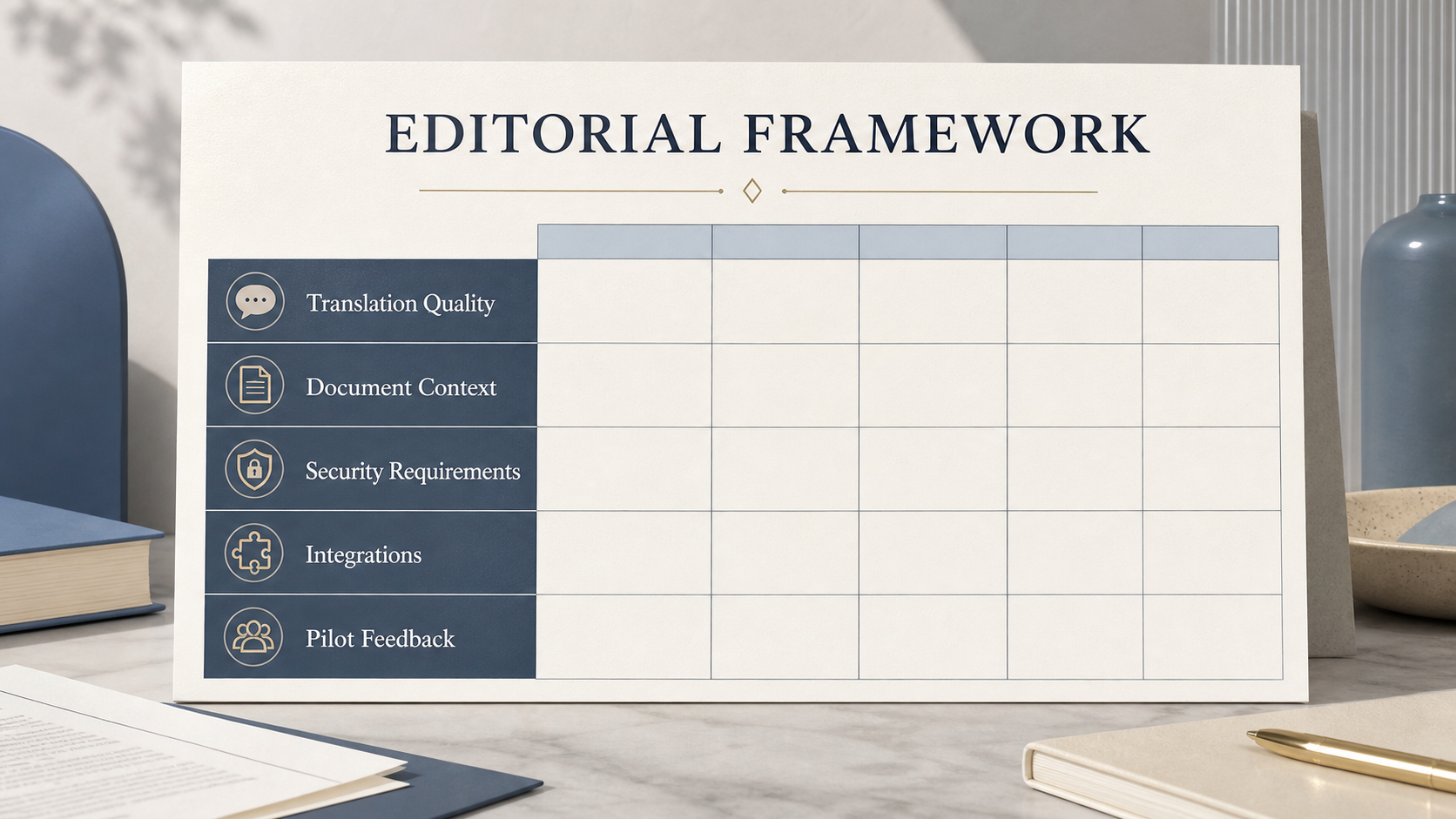
Start with a short, controlled pilot rather than a generic benchmark. Gather representative samples from the workflows that would actually use the service: customer communications, product copy, internal material, documents or other approved content. Include the language directions, formats and terminology that matter to the organisation. If consistency across longer content is important, test full documents as well as isolated passages; the independent study shows why document-level assessment can reveal differences that segment-level evaluation misses.[^study]
Create a small scorecard before viewing outputs. Assess meaning accuracy, naturalness for the intended audience, terminology consistency, tone, formatting, required post-editing and reviewer confidence. Where relevant, include how the tool would connect to existing work. DeepL identifies API and integrations as parts of its business offer, including Microsoft Word, Google Workspace and Microsoft 365, but confirm the precise fit and availability in your own proposed arrangement.[^official]
Run the same material through each shortlisted option, preferably with reviewers who understand the content and target language. Blind review can reduce brand bias. Record not only a preference score but also the reason for it: a terminology problem, a missing contextual reference, a format issue or excessive reviewer effort can be more actionable than a general impression.
Then assess governance and total cost alongside output. Confirm the proposed terms for the product components you intend to use, implementation steps, access model, security requirements, data handling, support and commercial structure. Set acceptance thresholds in advance and include a small feedback loop with actual users. A pilot is more informative than generic benchmarks because it tests the combination of content, reviewers and controls that your team will operate. For a fuller process, see the site’s language-technology procurement checklist.
{{primary_cta}}
Frequently Asked Questions
Is DeepL for Business suitable for UK organisations?
It may be suitable when its language tooling and workflow fit match the organisation’s needs. DeepL’s official material covers translation, writing, voice, API and integrations, while the supplied editorial evidence supports considering its natural-sounding and contextual translation positioning.[^official][^techradar] Suitability still depends on your language pairs, content, governance and contract terms.
How should teams test DeepL translation quality before buying?
Use a controlled pilot with representative content, the actual language directions and reviewers who understand the use case. Assess complete documents where consistency matters, not only isolated segments. This follows the independent study’s warning that document-level evaluation can uncover differences missed in segment-level assessment.[^study]
Can DeepL replace professional human translators?
The supplied evidence does not support that conclusion. Machine translation can be evaluated as part of a workflow, but high-stakes, specialist or approval-sensitive material may still need human linguistic review. Decide this through a pilot and the risk level of the content, not through a general marketing claim.
What should procurement teams check in a DeepL business proposal?
Confirm the exact product components and integrations in scope, then assess security, data handling, access, support, implementation and total cost against your requirements. DeepL’s official material signals a broad product range, but it does not establish the terms of an individual proposal.[^official]
[^study]: Independent document-level comparison of DeepL and Supertext (ev_132aa9c76a6564f6). [^techradar]: TechRadar Pro overview of DeepL (ev_2b94902b20f757fa). [^official]: DeepL product and quality overview (ev_4a6fd0b9dc8dd389).
Related reading
- How to choose a business translation service for UK regulated teams
- Translation agency vs language-AI platform: procurement trade-offs for UK teams
- Best business translation service models for UK procurement teams
- Unbabel review: Language Operations fit, acquisition context, and procurement questions
Editorial information: About our editorial team · Read our editorial policy · Read our affiliate disclosure.