UK procurement teams should choose a language-service model before comparing suppliers. The right choice depends on the mix of services required, the level of governance needed, and whether a repeatable digital workflow can safely cover part of the requirement.
Verdict: Choose the Service Model Before the Supplier
For a requirement that combines accountable quality processes with several language-service modalities, start with a managed language service provider (LSP) model. The current Crown Commercial Service (CCS) Procurement Language Services framework demonstrates why: its scope spans translation, transcription and recording, telephone interpreting, video interpreting, and face-to-face interpreting, organised into five lots including overseas requirements. [Evidence: ev_e22ad4cbedf98a99]
That does not make a managed LSP universally preferable. A technology-led platform can be a practical option for repeatable digital-content workflows where the scope, review arrangements and risk tolerance are clearly defined. Independent editorial coverage of translation software reflects the breadth of platform use cases, including quality, freelancer, enterprise and collaboration-oriented options. [Evidence: ev_44d41bb78c2ee846]
The procurement decision is therefore not “which provider is best?” It is whether the proposed model gives the organisation sufficient service coverage, control and accountable delivery for the work it actually needs to buy.
The Translation Service Models UK Teams Can Buy
A managed LSP coordinates delivery through a supplier relationship that can cover multiple language services. This model is most relevant where procurement needs one accountable route for more than written translation, or where service coordination matters alongside the individual job.
A technology-led translation platform centres on software-enabled workflow. It may support the translation of digital assets and collaboration, and it can be useful where work is repeatable and the buyer can define the controls around it. Editorial comparison coverage groups products around different priorities, such as quality, freelancer use, enterprise use and collaboration, which is a reminder that “translation software” is not one uniform category. [Evidence: ev_44d41bb78c2ee846]
A specialist freelance network is a more focused sourcing model, often considered where a particular language pair or defined assignment is central to the requirement. A hybrid model combines platform workflow with managed oversight or specialist resourcing.
Coverage matters because translation and interpreting are not interchangeable services. The CCS framework explicitly separates translation; transcription, stenography and recording; telephone interpreting; spoken and visual video interpreting; and spoken and visual face-to-face interpreting. [Evidence: ev_e22ad4cbedf98a99] A specification should state which of those modalities are in scope rather than assuming a supplier’s translation offer includes them all.
Strengths of the Managed Language Service Provider Model
The managed LSP model is strongest when a buyer needs coordinated delivery across several services, languages or internal stakeholders. The CCS framework is a useful public example of a comprehensive structure: it covers five distinct service components and includes a lot for overseas requirements. [Evidence: ev_e22ad4cbedf98a99]
That breadth can simplify governance. Rather than separately managing written translation, interpreting and related requirements, the buyer can assess whether a supplier’s proposed operating model, escalation route and reporting process work across the required scope. It also creates a clearer place to test accountability for service performance.
Quality expectations should be made explicit in the procurement documents. The Association of Translation Companies describes ISO standards for the language-services industry as setting basic requirements and quality expectations, and as criteria against which the professionalism of LSPs can be objectively assured. [Evidence: ev_4dee3c7576fb3d77] In practice, ask bidders to explain how their processes meet the relevant requirements for the specific services being bought, rather than treating a reference to standards as a substitute for a delivery plan.
Strengths of Technology-Led Translation Platforms
Technology-led platforms can add value where an organisation has a repeatable flow of digital content and wants faster access to translation tools or collaboration features. Independent editorial coverage of business translation software focuses on helping businesses streamline communication with global audiences and distinguishes products aimed at quality, freelancers, enterprises and collaboration. [Evidence: ev_44d41bb78c2ee846]
For procurement, the attraction is operational: a defined workflow can be easier to route, track and reuse than an ad hoc request process. This can suit lower-risk content where the buyer has clearly specified what may be processed through the platform and what review is required.
However, software convenience is not evidence that every workflow has suitable human review, specialist-domain capability or interpreting coverage. The CCS framework’s separate service categories illustrate that telephone, video and face-to-face interpreting are distinct procurement needs alongside translation. [Evidence: ev_e22ad4cbedf98a99] Buyers should test those needs directly instead of assuming a translation platform replaces a managed service model.
Limitations and Procurement Risks to Test
The central risk is buying a model whose apparent capability is broader than its contracted service scope. The public CCS framework lists separate components for translation, transcription and recording, telephone interpreting, video interpreting and face-to-face interpreting. [Evidence: ev_e22ad4cbedf98a99] A supplier comparison should therefore map each required modality to an explicit delivery commitment.
Fragmented sourcing can also make accountability harder to manage. If a platform, freelance network and interpreting provider are used separately, the buyer should define who owns intake, quality checks, issue escalation, data handling and reporting. The issue is not that a fragmented model is always unsuitable; it is that its controls must be designed rather than assumed.
ISO-related standards are useful quality criteria, but they are not an automatic guarantee that every supplier, language pair or workflow is suitable. The ATC describes the standards as establishing basic requirements and quality expectations for language services. [Evidence: ev_4dee3c7576fb3d77] Validate the supplier’s process, the scope to which it applies, and the evidence it will provide during contract management.
Alternatives: Freelance Networks and Hybrid Delivery
A specialist freelance network may be worth considering for focused work where a particular language pair, subject area or assignment is the main requirement. It can offer a more targeted sourcing route than a broad managed contract, but the buyer still needs to establish who validates capability, provides continuity and resolves quality issues.
A hybrid model can combine a platform’s workflow benefits with managed oversight where the requirement warrants it. This may be appropriate when repeatable digital content can be handled through a defined process, while higher-risk, specialist or multi-modal work is routed for additional management. The range of software priorities identified in independent editorial coverage—quality, freelancer, enterprise and collaboration—supports treating platform capability as one evaluation dimension rather than a universal replacement for managed service. [Evidence: ev_44d41bb78c2ee846]
Assess both alternatives against the same questions used for an LSP: which services are in scope, what controls apply, who is accountable, and what evidence will demonstrate performance.
Shortlist Framework for UK Procurement Teams
AI-generated generic editorial illustration — not a retailer product photo and does not depict the reviewed product or service. Help procurement teams compare service models against their operating requirements rather than rely on supplier rankings.
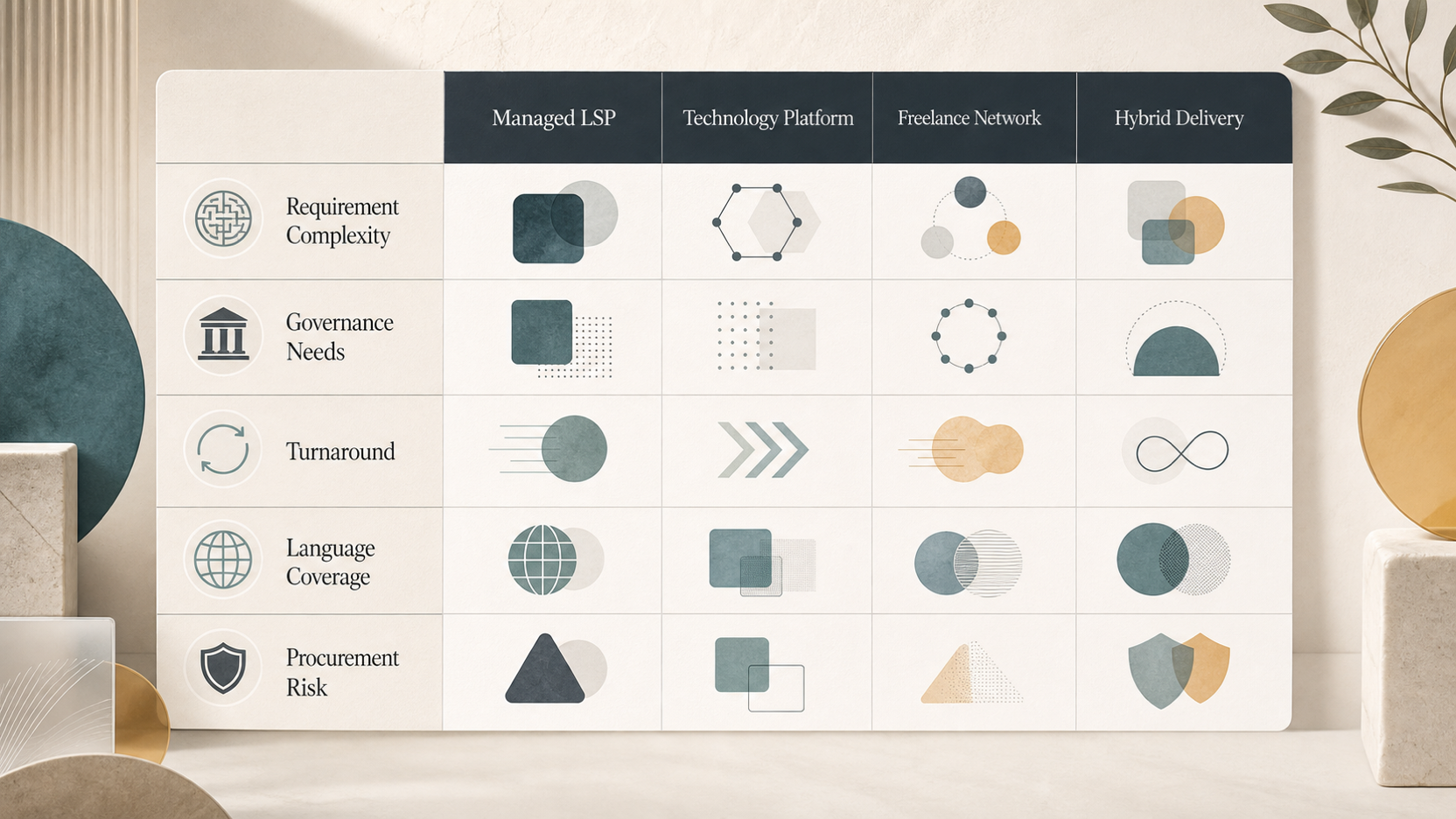 Build a shortlist from requirements, not marketing categories.
Map the required services. Identify whether the contract needs written translation only or also transcription, telephone interpreting, video interpreting, face-to-face interpreting and overseas coverage. The CCS framework shows these as distinct components, not minor variations of one service. [Evidence: ev_e22ad4cbedf98a99]
Set the governance threshold. Where several modalities, internal users or higher-consequence content are involved, prioritise models that provide a clear accountable delivery structure. Where the workflow is repeatable and lower risk, test whether a technology-led platform with defined review controls is sufficient.
Separate workflow from assurance. Ask how work is received, assigned, checked, escalated and reported. For technology-led proposals, ask which content types are suitable for the platform, what human review is included, and how exceptions are routed. For managed proposals, ask how service coordination works across the required modalities.
Test quality claims against the contract. ISO-related standards can provide relevant criteria for language-service quality expectations, but the ATC’s description should be used as a starting point for procurement questions, not as a blanket assurance. [Evidence: ev_4dee3c7576fb3d77]
Check contract fit. Confirm language coverage, volume assumptions, turnaround commitments, escalation contacts, reporting, data-handling requirements and the route for adding services. A model that is effective for one defined content workflow may not cover interpreting or a broader operational requirement.
This approach produces a defensible shortlist without claiming that one supplier is the universal best. It gives each model the chance to demonstrate fit against scope, controls and accountability.
Frequently Asked Questions
Should UK procurement teams buy translation and interpreting through the same contract?
They can do so when the requirement benefits from coordinated coverage and accountability. The CCS Procurement Language Services framework includes translation alongside telephone, video and face-to-face interpreting, plus transcription, stenography and recording. [Evidence: ev_e22ad4cbedf98a99] A combined contract is not mandatory, but the buyer should ensure every required modality is explicitly covered.
Do ISO-related language-services standards guarantee translation quality?
No. They establish basic requirements and quality expectations and provide criteria for objectively assessing LSP professionalism. [Evidence: ev_4dee3c7576fb3d77] Procurement teams should still validate the supplier’s process, applicability and contract-management evidence for the services in scope.
When is a technology-led translation platform sufficient for business use?
It may be sufficient for a clearly defined, repeatable and lower-risk digital-content workflow where the buyer has specified appropriate review and exception controls. Technology products are positioned for varied uses, including quality, freelancer, enterprise and collaboration needs. [Evidence: ev_44d41bb78c2ee846] It should not be assumed to cover specialist review or interpreting without direct evidence in the proposal.
Sources
Related reading
- DeepL for Business for UK teams
- How to choose a business translation service for UK regulated teams
- Translation agency vs language-AI platform: procurement trade-offs for UK teams
- Unbabel review: Language Operations fit, acquisition context, and procurement questions
Editorial information: About our editorial team · Read our editorial policy · Read our affiliate disclosure.