Decision at a Glance
There is no universally best corporate language-training provider. For a UK employer, the right model is the one that fits a documented business need, the required delivery format, the level of central administration and the way learning impact will be assessed. CIPD frames effective learning and development around a strategy, needs analysis, intervention design and impact measurement, so procurement should start with those questions rather than a supplier feature list.[^cipd]
An enterprise managed platform can suit organisations that need coordinated enrolment, reporting and a mix of digital and live learning across locations. EF Corporate Learning, for example, describes an AI-native platform with personalisation at scale, live online classes, reporting and integration; its outcome comparisons are supplier-reported and based on client surveys, so they should be treated as claims to test in a pilot rather than as an independent ranking.[^ef]
Specialist tutor-led, blended and internally run routes can be stronger where the audience, language use case or local context needs close tailoring. Shortlist models conditionally, then agree evidence, uptake and evaluation criteria before contracting.
How Corporate Language Training Provider Models Work
 Corporate language training is an operating model, not simply a library of courses. The procurement question is how an employer will identify capability gaps, match people to learning, support participation and determine whether the intervention transfers into work. CIPD identifies learning needs analysis, delivery methods and learning evaluation as connected parts of an effective L&D approach.[^cipd]
Four broad models are useful for comparison:
- Enterprise managed platforms centralise administration, learner access, reporting and, in some cases, integrations. They commonly combine self-directed digital practice with scheduled live sessions.
- Tutor-led specialist programmes put an instructor, cohort design and job-relevant practice at the centre. They can work well for smaller groups with a clear professional communication requirement.
- Blended providers combine digital learning, live tuition, coaching or workshops. The balance should follow the skill to be developed, learner availability and expected workplace use.
- Internal, marketplace-led or local provision gives the employer more choice over suppliers and formats, but also leaves more coordination, quality assurance and measurement with the employer.
EF’s public offer illustrates the enterprise-platform category: it promotes smart personalisation, live online classes, reporting and integration for global businesses.[^ef] Those features describe the supplier’s offer; they do not establish that the model will outperform alternatives for every UK workforce.
Strengths of the Main Provider Models
Enterprise managed platforms may offer a practical route to consistent administration when many teams, locations or learner levels are involved. A single provider relationship can simplify enrolment, reporting and governance, while a digital-and-live mix may give employees more than one way to engage. EF states that it provides personalisation at scale, live online learning, reporting and integration, which are relevant capabilities to examine in this model.[^ef]
Tutor-led specialist programmes can be attractive when the need is narrow and observable: for example, customer meetings, technical presentations or manager communication. A provider can shape sessions around realistic language tasks and give direct feedback. This does not remove the need to establish the learning need first or to evaluate whether learning is used at work.[^cipd]
Blended models can give procurement teams more design flexibility. Digital activity can support practice between sessions, while live delivery can be reserved for speaking, feedback and application. CIPD’s focus on choosing delivery methods as part of an intervention supports selecting the mix for the need rather than treating any one format as automatically superior.[^cipd]
Internal or marketplace-led provision can preserve local relevance and allow teams to use established partners. Its main advantage is control over the learning ecosystem; its main cost is the employer’s added responsibility for supplier coordination, data consistency and quality assurance.
Limitations and Procurement Risks
AI-generated generic editorial illustration — not a retailer product photo and does not depict the reviewed product or service. Help procurement teams assess provider claims against needs analysis, delivery design, and measurable learning impact.
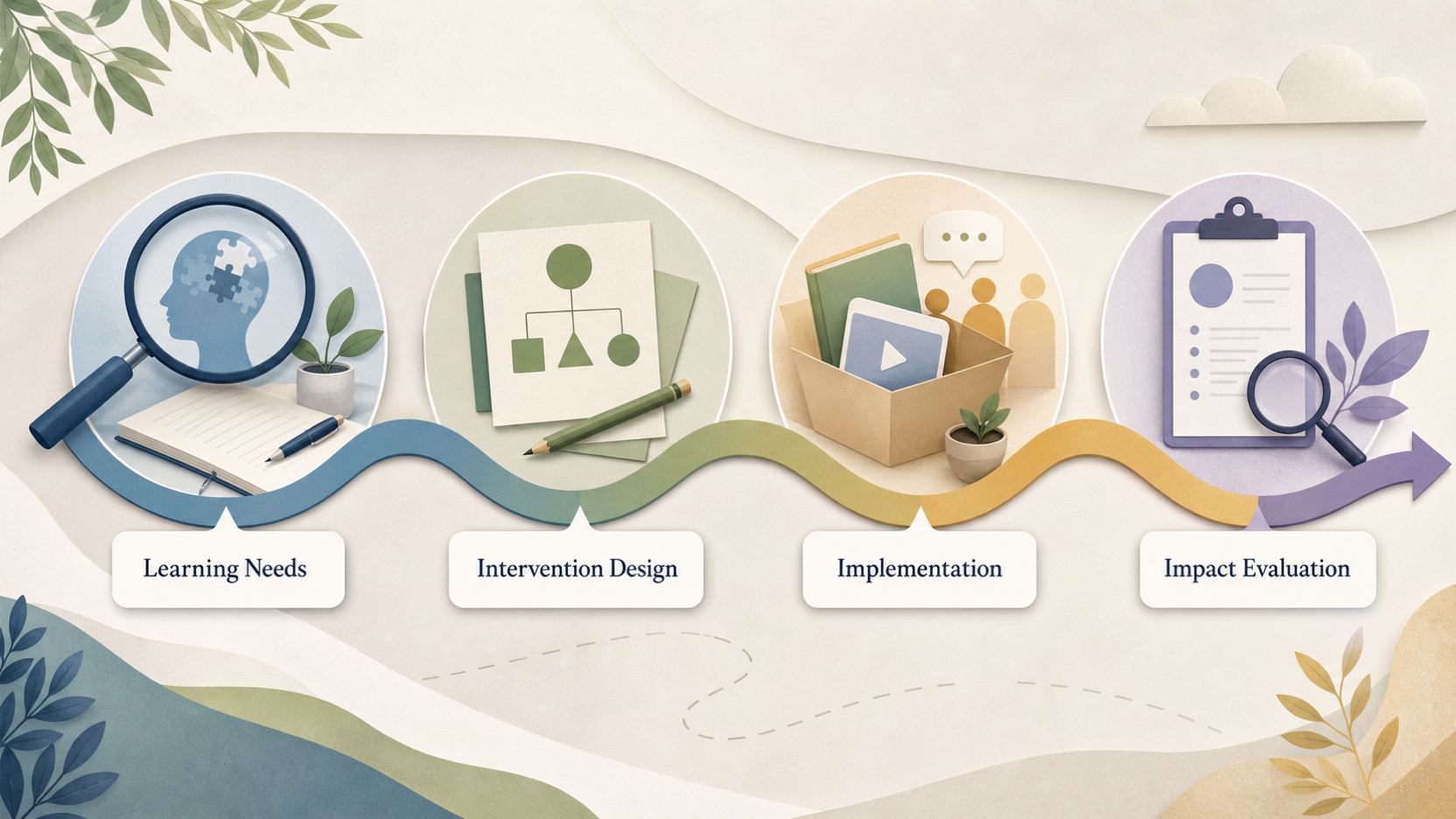 The headline risks are not limited to course quality. A well-designed programme can still underperform if learners lack protected time, managers do not reinforce use, enrolment is poorly targeted or participation data is mistaken for capability improvement. CIPD distinguishes needs analysis, intervention design and learning-impact evaluation, which means procurement should test the whole chain.[^cipd]
For an enterprise platform, ask how identity, learner data and reporting will integrate with existing systems; who owns implementation; what support is included; and whether reporting shows attendance, progress and work-related outcomes separately. For tutor-led programmes, test tutor matching, continuity, availability, accessibility and how consistent the learner experience will be across cohorts. For all models, clarify commercial commitments, minimum volumes, change controls, data protection responsibilities and exit arrangements.
Supplier outcome figures need careful treatment. EF publishes comparative claims about engagement, learning progress and usage, but labels the results as based on client surveys.[^ef] A procurement team should request the methodology, denominator, timeframe and comparison basis, then validate the measures against its own baseline and pilot criteria.
Alternatives to a Centralised Provider
A central external provider is not always the best operating choice. An internal academy may fit where the organisation already has strong L&D capability, a stable learner population and subject-matter experts who can embed language practice in business scenarios. It provides close alignment but requires the employer to design, administer and evaluate the intervention.
Individual learning budgets or a curated marketplace can suit diverse, self-directed populations. They increase choice and can be faster to launch, but central control over quality, learner support, data and outcomes is lower. Local training partners may be preferable where regional context, in-person delivery or a specific language community matters most.
Self-directed digital learning is a lower-touch alternative for employees with clear goals and enough time to practise independently. It is less suitable where the business need depends heavily on live speaking practice, feedback or behaviour change. CIPD’s guidance supports selecting learning methods in relation to the identified need and evaluating their impact, rather than assuming that centralisation or flexibility alone creates value.[^cipd]
Shortlist by Employer Need
Use the following as a starting shortlist, then convert it into a written pilot hypothesis.
| Employer situation | Models to shortlist | What to ask providers to prove |
|---|---|---|
| Large, distributed workforce needing common administration | Enterprise managed platform; blended provider | Implementation ownership, reporting definitions, integration approach, learner support and uptake plan |
| Sales, customer-facing or leadership cohort with defined communication tasks | Tutor-led specialist programme; blended provider | Tutor expertise, cohort design, practice tasks, feedback method and observed capability baseline |
| Mixed learner needs across business units | Blended provider; managed marketplace; internal academy | Segmentation method, governance model, data consolidation and escalation paths |
| Strong internal L&D team and local business knowledge | Internal academy; selected local partners | Internal delivery capacity, facilitator quality, manager involvement and evaluation plan |
| Low-budget exploratory need | Time-boxed pilot; self-directed digital option; local partner | Target population, completion assumptions, support required and a decision rule for scaling |
Before contract award, define the target group, business-relevant baseline, delivery period, minimum acceptable participation, accessibility requirements and measures that distinguish activity from impact. CIPD identifies learning needs analysis and evaluation as core L&D steps, making these practical procurement requirements rather than optional reporting extras.[^cipd]
Ask each finalist to demonstrate the learner journey, administrator workflow, reporting export and implementation plan using a realistic cohort. For supplier-reported results, request the evidence behind the claim and decide in advance which local pilot outcomes would justify expansion.[^ef]
Next step: use the language-training RFP template to turn these proof points into consistent supplier questions, then apply the corporate-learning pilot checklist before committing to scale.
Frequently Asked Questions
How should UK employers measure whether language training is working?
Start with the capability and business need identified before launch, then measure at more than one level: participation and completion, relevant language progress, confidence or performance in defined work tasks, and evidence of transfer where feasible. CIPD presents learning evaluation and impact as part of the wider L&D process, so attendance alone is not a sufficient outcome measure.[^cipd]
What should a corporate language-training pilot include?
Use a clearly defined learner group, a stated business use case, a baseline, a fixed delivery window and agreed success measures. Include implementation responsibilities, learner-support arrangements, accessibility checks and a decision rule for scale, redesign or exit. Ask the provider to show how it will report both engagement and progress, and test supplier-reported outcome claims against the employer’s own data.[^ef]
Should employees learn through live classes, digital modules, or a blend of both?
Choose the format after identifying the learning need. Live teaching can support speaking practice and feedback; digital modules can support flexible practice and reinforcement; a blend may suit needs that require both. CIPD advises employers to consider delivery methods as part of designing an effective learning intervention, not as a one-format procurement default.[^cipd]
[^cipd]: CIPD, Learning and development resource hub (independent editorial evidence, ev_808c0656b44be0b9).
[^ef]: EF Corporate Learning, Corporate language learning (official evidence, ev_3d05a2fccc38d123).
Sources
Related reading
- How to procure interpreting services for hybrid meetings and regulated conversations
- Remote interpreting vs on-site interpreting: which service model fits your organisation?
- Unbabel review: Language Operations fit, acquisition context, and procurement questions
- How to reduce business language-service spend without weakening quality controls
Editorial information: About our editorial team · Read our editorial policy · Read our affiliate disclosure.